



Growing Industries Marketers Should Look Out For in 2026
Marketers have to keep abreast of the most important happenings in the business world. In this same spirit, we’ll be breaking down the most important growing industries and mature markets that we should keep track of in 2026. Whether you dwell in these waters or are simply looking for prospective clients, here are some pointers for where to look.
Which Industries Are Growing in 2026?
The top growing industries to look out for in 2026 and beyond include:
- Fintech services
- Solar and renewables
- IT and cybersecurity
- eCommerce and digital retail
- Healthcare and biotech
- Advanced robotics
When creating a list of the largest growing industries, we looked at the Compound Annual Growth Rate (CAGR) and simpler growth rate measures (whichever you can reliably find). We’re also assessing these industries in terms how safe they are in terms of future projections, making them more viable as long-term marketing prospects.
Financial Services Industry Growth Projections
The fintech and banking industry growth numbers show that the market is a steady grower. While not displaying the biggest growth compared to some others on this list, this one has massive potential for marketers. As of 2024, the global FinTech market managed to reach an estimated value of $310 billion, with a CAGR of 19.5% over the previous five years.
This was caused by the increased adoption of digital payment programs, lending platforms, blockchain, and regulatory technologies. North America and Asia have been a steady source of funding, with Silicon Valley and Singapore leading the charge. Similarly, emerging markets in Africa and Latin America are also experiencing notable growth. Many areas with untapped potential may provide a growing base of clients for many marketing firms, with new applications they can promote.
Our only reservations are that the Fintech and financial services industries are possibly heading for a downturn. Despite global economic uncertainties, investments within the market have flourished. However, fears of a looming downturn are growing louder, which may mean one should proceed with caution.
Fintech stock values have dipped somewhat, but with companies like Visa and Mastercard, they are holding strong. With many new entrants which provide banking services or lending, there is a whole host of additional FinTech services that are gaining interest as alternatives.
China’s Renewable Energy Industry Takeover
Semiconductor industry growth numbers are revealing the extent of Chinese dominance in the field. Not only are they providing some of the cheapest solar panels on the market, but they are also outpricing competitors, leading to an oversupply crisis. Chinese panels have dominated the industry to the extent that Asia’s solar boom is credited largely to their work. Mordor Intelligence estimates that the market will grow to twice its current size by 2030 (from 1.23 gigawatts to 2.5 gigawatts).
China has been particularly prevalent in countries where renewables receive tax exemptions and subsidies. This strategy has meant they could apply a penetration strategy in many regions of Europe, outpricing local companies. Still, since renewables require many links in the chain till the end-consumer. These various links in the chain are a goldmine for marketing professionals, who can reach out to private sellers, renewables companies, installers, electricians, and more.
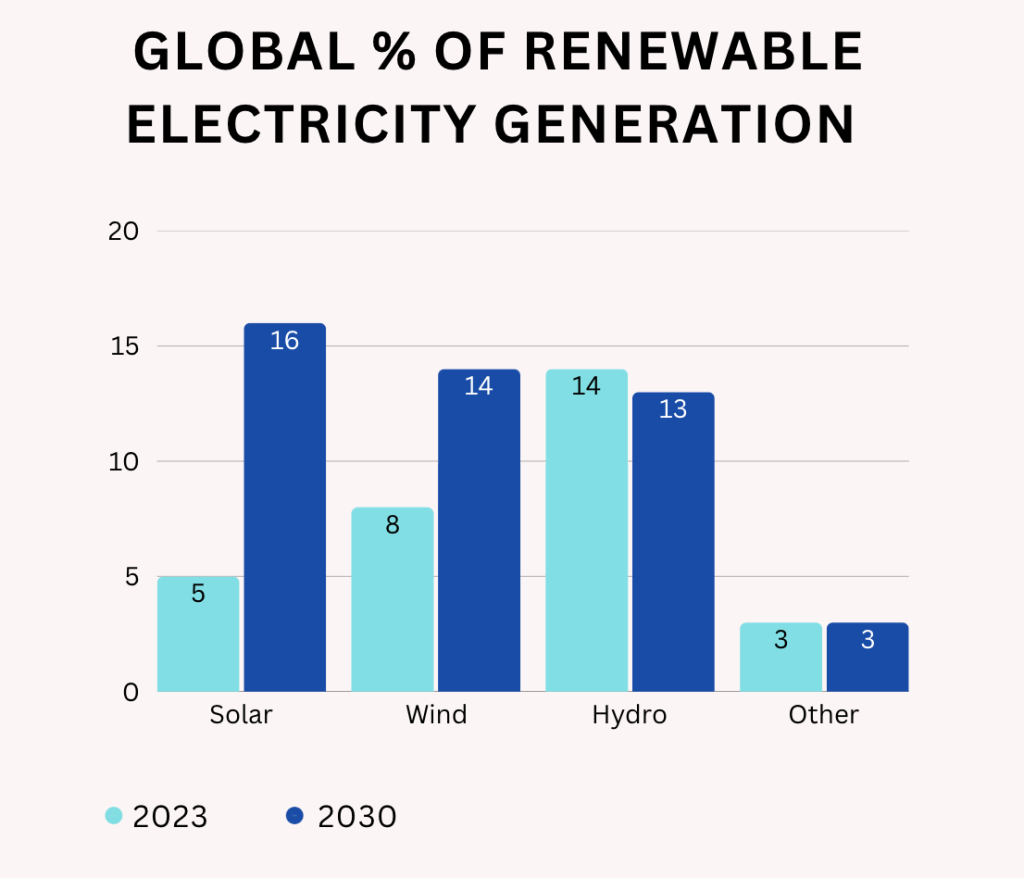
The International Energy Agency estimates that by 2030 solar will be the biggest player in the world of renewables outpacing hydro, wind, and many others. Solar is set to go from 5% or energy production (from 2 years ago) to 16% by 2030. Wind is also slated to grow alongside it but with relatively less growth.
Our only reservation is that the industry might reach maturity and saturation soon. There is a fear that the assumptions that allow for the growth in renewables may not hold uniformly. For example, many governments are scaling back their subsidies partially because of governments that are hostile to renewables and partially as a crackdown against China’s dominance. This may slow down adoption in the future if it persists.
IT & Cybersecurity
The market for IT and cybersecurity has grown in tandem with new technologies that present threats to both IT and security. This makes it one of the surefire bets for the next few years, especially as the speed and complexity with which we make new programs and software. Another facet that has hypercharged the need for both these industries is the growth of work from home and remote work.
With the rise in data breaches and cyber attacks, experts like ExpressVPN estimate $8 trillion in damages globally. This has led to many companies feeling the need to beef up their systems to create a better, safer work ecosystem. The Bureau of Labour Statistics expects roles in this sector to reach an average annual salary above $120,000, and to grow 32% in number the coming decade.
In fact, cybersecurity represents a major avenue for many companies that might cut their dev teams down in hopes of cutting costs with AI. The new trends within the field include biometric authentication, AI-driven threat detection, and zero-trust architectures. These will all become core aspects that may provide a lot of B2B marketing opportunities.
Trends in eCommerce & Digital Retail Present New Opportunities
While retail has been growing over the past few years, changes within the industry have enabled new, smaller entrants that may require more elaborate marketing services. Smaller retailers and resellers, along with companies offering business models such as “buy now, pay later” or instalment-based payment packages, are offering a range of new deals that cut through the competition.
Sales via online platforms accounted for over 15% of all global retail revenue. The US Census Bureau estimated the industry to be worth $1.1 trillion by 2024. Aside from the major retailers, the industry has also introduced entrepreneurs starting their own online stores. Smaller niche eCommerce outlets also provide marketers with an opportunity to advise growing companies.
US retail sales for the third quarter of 2025 amounted to $299.6 billion, displaying an increase of 2.2% (±0.4%) from the previous quarter. The next quarter of 2025 increased by a further 5.2 % (±1.2%). Total eCommerce sales in the third quarter were 15.8% of sales. This growth has been steady for companies for many years.
Healthcare & Biotech Grew Since the Pandemic
Healthcare and biotech have seen increased interest from both the public and investors in recent years. One factor is the pandemic itself, but it’s not the only aspect of this growth. Due to an ageing population and growing interest in self-care, many pharmaceutical and health-centric products have seen an uptick in sales.
In the US, the healthcare sector is one of the largest employers in the world. At last count, there were 18 million jobs in the sector owing to ageing care, chronic disease management, and post-pandemic staffing recovery. Some say that 1 in 8 people in the country are employed in healthcare. Similarly, healthcare expenditure and investments are increasing throughout Europe, with Germany, France, and Italy being promising markets.

Aside from traditional pharma, there are biotech firms and cosmetic drugs (like GLP1s such as Ozempic) that are growing in popularity. Venture capital funding for biotech in the U.S. and Europe increased to $28.1 billion in 2024. Similarly, India alone has been a massive market, reaching $150 billion in 2025. Marketers can find many new leads in these industries as both the private and public sectors are growing.
Automation & Advanced Robotics
Industrial robotics is a massive B2B business, with a few applications making it over to high-end B2C products. Automation isn’t just the flashy, large-scale industrial machines, as this can also involve terminals at fast food places or even supermarkets. These present not just opportunities for the actual robots, but also for their software development. As an industry that is still finding its footing, marketers play an outsized role in communicating its importance and applications.
In 2022, China installed a record 290,258 industrial robots, making up 52% of the global market. The global stock of industrial robotics reached 3.9 million units in 2023, with the number slated to grow even higher in 2026. Robots are widely used in factories, agriculture, and medical settings. Add to this the drone market, and there are many places where our little, metallic helpers can make their mark.
What are the Fastest Growing Industries in 2026?
While many of the same industries are in the list of fastest growing markets, they are not identical. Industries can be existing and large, but they can also be a small yet accelerating force within the market. The fastest growing industries in the next 5 years are:
- Hotels and Restaurants (2% global revenue growth): Hospitality has bounced back after the pandemic. As the younger generations have geared their spending towards experiences rather than product ownership, there are many opportunities in this market.
- Renewable Energy (10% to 17% CAGR): As we’ve covered, energy crises due to traditional energy generation, subsidies, and China’s manufacturing have given new legs to the renewables industry.
- Transport post and storage (2.6% global revenue growth): Shipping and posting things have never gone out of fashion. Coinciding with the growth in digital retail, this
- EVs and Batteries (22% to 25% CAGR): EVs and electric batteries are a major growth market as the world tries to transition away from fossil fuels.
- Digital Retail (14% to 25% CAGR): Online shopping is slated to grow faster, along with other eCommerce applications, fast shipping, and rent-to-own platforms.
- Healthcare & Telemedicine (18% to 25% CAGR): Healthcare and telemedicine have become more prominent as many popular
The Question of AI

It’s worth noting that the fastest-growing industries in the US also include AI, digital retail, and renewables. The fastest-growing US industries differ slightly from the rest of the world due to how much they are investing in particular technologies like LLMs. Artificial intelligence, or AI, is still a growing industry, but there are many questions that need to be resolved before we can recommend AI as a good bet for marketers (specifically as clientele).
AI’s growth is difficult to accurately gauge because there is massive growth in stocks, but platforms are yet to break a profit due to exorbitant costs. This has led to negative AI stock market predictions and accusations of a bubble. While the prediction of a market crash has picked up steam in recent years, companies believe they can ride out the whole era and come out the other end with enough revenue once the ubiquity of the technology is achieved.
Another reason is that numerous AI-powered systems appear to be false advertising or rug pulls. In that sense, the AI boom is similar to crypto, where a crowded market has a few winners with exorbitant resources, with many other companies that are less viable (or straight-up untrustworthy). Basically, approach AI firms with some level of scepticism, even though there is a lot of investment in the industry.
Steadily Growing Industries Are a Safer Bet
Those industries that are growing at a steady rate can often be overlooked, but may be a better bet for marketers. It’s best to target those markets with established. long-term staying power and a wider spread of services. For example, healthcare, pharma, and telemedicine are very wide-ranging industries with a lot of links in the chain (manufacturers, service providers, clinics, patients, consultants, advisers, etc.). This allows any marketer to cast a wider net when looking for clients.
IT and cybersecurity have a similar width of clientele. As applications grow and companies expand rapidly, the field gains many opportunities. This is ample room for future growth on many different levels. Riskier industries like AI and robotics, in contrast, will have a lot of winners and losers. This is part and parcel of tech because it is so much more labour-intensive on every level, with very little room for smaller companies.
This is not to say that these industries with a backing of lower-level small business operations can’t be profitable. Rather, these businesses are high-risk and high-reward, especially in regions of rapid growth. As with all things, one must tread carefully, as anything can change in the coming months.