


Backlink Strategy: Application & Link Acquisition
With the SEO game becoming more and more complex, backlink strategies have remained a reliable ranking technique. However, this is easier said than done, which is why we’re breaking down some notable workflows for developing your own processes. So, let’s discuss how to build backlinks:
Preparation
Before finalising your strategy, you will need to do a comprehensive backlink audit. The best backlink strategy for your website can vary based on the topics you cover, who wants to link to you, and the keywords you want to target. Any backlink strategy for SEO requires understanding the gaps in your competitors’ work and exploiting them. We have published a more comprehensive breakdown of backlink gap analysis, so be sure to check that out.
After an audit, be sure you have backlink tracking figured out. Set up some KPIs, and then figure out how to measure them with benchmarks in place. Here are a few KPIs you can use:
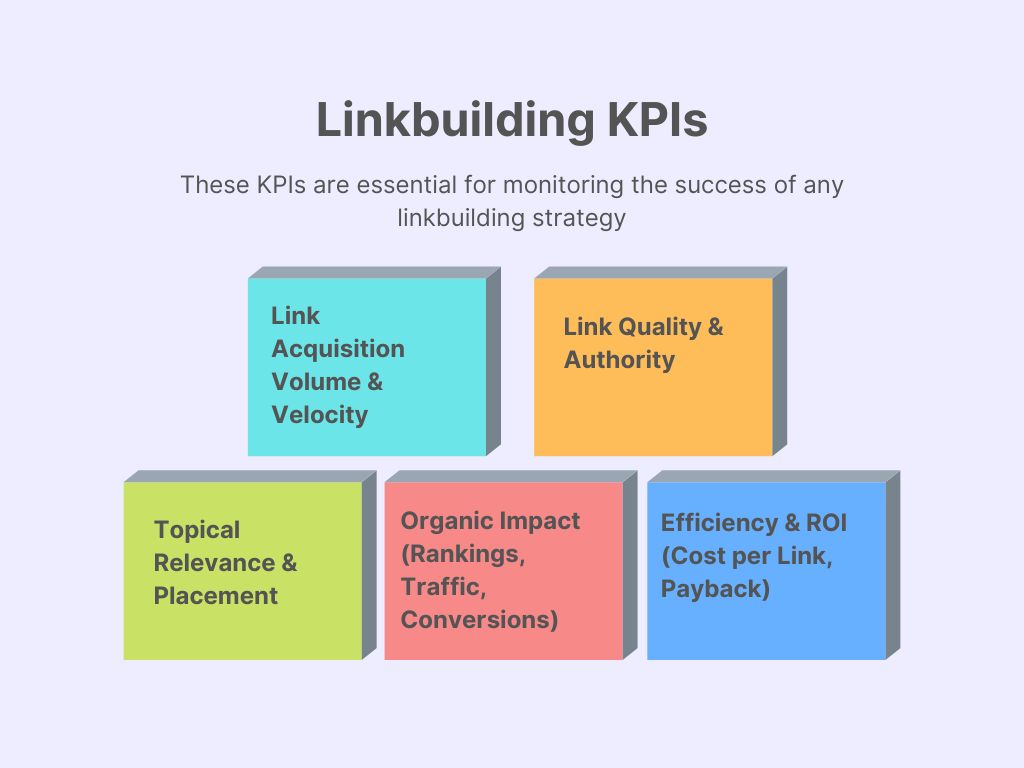
- Link Acquisition Volume & Velocity: Tracking the pace and scale of your link-building. This ensures that you are growing at an appropriate rate.
- Link Quality & Authority: Improving the quality of your domain and building authority requires getting links from high-value websites. Higher values are often found with org sites, government sources, and academic institutions.
- Topical Relevance & Placement: Topical alignment and keyword placement ensure you will perform better in the right topic clusters.
- Organic Impact (Rankings, Traffic, Conversions): Measuring the growth of the site since the implementation of backlinks. This can be done in search rankings, traffic increases, or conversions.
- Efficiency & ROI (Cost per Link, Payback): This is the financial return on your investment, which measures the effectiveness and sustainability of your strategy. These can be measured by subtracting the cost of each link or the whole campaign from any gains achieved by it.
After picking the goal and the KPIs, you need to create a list of viable websites that serve as high-quality links. Focus on high authority, domain rankings, and topic relevance. Once your list is prepared, you can move on to implementing your desired SEO backlinking strategy properly.
Getting backlinks is the next step in the process, allowing you to make gains in rankings. Here’s how to obtain backlinks:
Backlink SEO Strategies
After finding a backlink gap, you can employ a series of strategies to exploit it. Let’s review some of the most common ones. We’ve broken them down into 3 categories:
- Brand-based or product-based: These strategies work best for branding or brands, however, they are good strategies for all sorts of sites regardless.
- Informational: These strategies can be great if you have a site that provides great information, or can be a good source for other pages.
- Content-based: These are strategies that promote your content using other content-based strategies. These include using images or other media.
- Gap-based strategies: These look at competitor gaps that can be obtained. Strategies of this type require more competitor analysis and looking for areas where you can compete with or take over their links.
These strategies can be mixed and matched (ideally, use them together if possible). We’ve divided them into these categories based on their optimal usage.
SEO Backlink Optimisation For Brands
If you want to elevate an existing brand, the best strategies are:
- Claim unobtained links
If your brand has been mentioned on sites already, you could do a Google search or look it up on an analysis tool. Google mentions can be great for this, along with setting up Google Alerts for your website or products. When you detect a mention of your brand or products, you can claim them by reaching out to the website. Importantly, you could also offer to improve the content and give your approval or post on your socials to sweeten the deal with the target site.
- Check for “best” lists or submit to them
Similar to the previous strategy, your company or website might end up on some lists that would benefit from mentioning your product or brand. If you are on a list but have an unobtained link or keyword, you can reach out to the site. If you run into a list or site that makes lists that might benefit from your product or brand’s presence, you can suggest it. Look up relevant lists, compare your brand or product to the other ones, and make your case to the website managers. Such lists have great SEO value, and many marketers theorise that they are also a major boost for AI search.
- Advertorials
As a brand, you can also offer to have articles written. The ethical and transparent way to do this is to make clear within the text that this is a sponsored article or is motivated by promotion. These articles can be about the benefits your product or services provide, or can highlight achievements the company has made. Smaller local papers can be a good target for this, along with blogs related to the relevant topic of choice.
Informational Strategies
- Find directories
Many think directories are outdated since their clicks have been falling, but they often have very high domain ratings. These can make them handy for linking signals and have great SEO value. The most obvious ones are Google Business profiles and claiming yourself on Google Maps, Bing Places, etc. Best of the Web and About Us can be great for businesses, so make sure you’re listed there as well. Domains like Blogorama can be great for content marketing websites.
- Backlink exchange
This strategy can be great for working with sites that would ordinarily be competitors. Offer to link to each other’s content on relevant topics. This will require reaching out to a competitor after some research. You will benefit most from being linked by higher-rated domains.
Content-based
- Guest-posting
Blog posts and guest blogging are a great strategy to elevate your website. This one does require quite a bit of work, but it can be worthwhile. This is particularly good if you can find high-ranking sites willing to let you write a guest post. While it can be more time-consuming to create content, there are also more benefits, as it provides a substantial boost and builds better connections with other sites.
- Infographics & PDFs
You can publish infographics and PDFs with links in them, offer them to other sites, and they can generate clicks to your site. Search engines like Google can index and read these documents, so it counts just as well. You can offer these to companies or websites that are likely to repost them on their web pages.
- Image linking
Much like the infographic strategy, it can be helpful to produce graphs or charts that other companies will want to link to. On a basic level, you could simply use a link that they can share, but some websites have widgets that allow for linking and embedding. These can boost your website as the image gets shared around, and you can track the image downloads or reverse image search the image to find websites that are using it but have not linked to it.
Gap-based Strategies
- Update broken or outdated competitor links
This is a great backlink gap strategy, but it looks for gaps in the target backlink source. You should look for where your competitors are linked, see if the links are active or relevant, and reach out to the linking website to replace it with one of yours. If you wrote about the same article as your competitor, but you have a more recent article, you can reach out to any website that may link to it.
- Local SEO backlinks
Many companies neglect local links with sites that operate in their area. This can be as simple as Google Maps optimisation, checking local websites and directories, and updating your local information.
- Skyscraper strategy
The skyscraper strategy relies on finding high-ranking pages and developing a better version of them. This one is more about identifying the gaps in your competitor’s content quality and exploiting them. While it can be difficult, it is a process that is content marketing companies use all over the world.
Backlink Outreach Strategies
A backlink outreach strategy is more about finding sources for external links and contacting them. This can help create backlink profiles through fellow or competitor sites. Let’s look at how to build an actionable strategy for acquiring backlinks:
- Create a list of websites and companies you can target: Use an analysis tool to decide which companies may benefit from links to your website or vice versa.
- Reach out to crucial personnel within the target companies: Personalise messages to the company, and be sure to use a professional or work email. Decide whether email or LinkedIn will be better.
- Create email templates: Creating your own templates is better for originality and for avoiding spam filters. Make sure they are readable and catchy.
- Use mass email tools with caution: Your emails will end up in the spam folder if you do not “warm up” your inbox. This can be done with various tools.
- Get ready to follow up: This part needs to be handled delicately. You can’t spam people, but you also need to remind partners who could be interested.
- Have a value proposition ready: Backlink exchanges or providing content are better than begging for links. It’s even better if you have good stats and believe your content is very shareable with their demographic.
FAQs
- What is a backlink strategy?
A backlink strategy is a series of procedures that helps you improve your website’s ranking with the use of external backlinks coming from other websites to your website. Backlinking helps websites perform better, improves SEO and rankings, and can help with detection by AI programs.
- How many backlinks do I need?
You need 40 to 100 backlinks for your site on the homepage. Subdirectories and inner pages will need anywhere from 0 to 100 links, depending on how competitive the keywords are. These pages may be so specific that they don’t need any backlinks, while high competition ones can require around 100.
- How to find backlinks to your site?
You can use software like SEMRush or Ahrefs to find out what sites are linking to yours or potential sites that might. You need to build backlinks that match the topic of your website, have high domain rankings, or are high-authority links like .edu sites or encyclopedias. Additionally, you can ask websites that have mentioned you to add hyperlinks to desireable pages.