



Query Fan-Out: How it Helps Understand AI Search
Understanding LLM query fan-out is a crucial part of AI search engine optimisation. Fan-out search queries open up a new understanding of how we can implement keywords. In this sense, it provides a novel approach to LLM search engines and SEO. Let’s go over what it is and how to use it for marketing.
What is Query Fan-Out?

A query fan-out describes a technique utilised by AI search engines, where search terms are split into related sub-queries to create a more robust, complete answer. An AI-powered search may not always return the precise keyword, so it will go to related entities, and this feature is far wider in scope than a standard broad search, as understood with classic Google SEO.
For example, if you look up “best SEO companies in Alabama”, there may not be that many companies that overtly call themselves “SEO companies”. For a standard query, this will be broadened to include keywords like digital marketing companies, marketing companies, SEO specialists, marketing consultants, etc. With fan-out queries, this will include all of those, plus things like SEO company Yelp and Google reviews, Google Maps information, Sortlist reviews, etc.
The style of search is different because the AI is trying to come up with an answer that turns links and data into information. It wants to come to a conclusion on the query, so it will collate a lot of different sources (in this case, reviews).
Here’s another example. Suppose you ask an AI, “I’m looking for a movie with a chase scene through the woods. Not horror”. It will probably look up movie summaries, reviews, Reddit pages like “r/movieslikethis” for the right keywords, discussion boards, and maybe even studies about cinematography. Because of the specificity of the query, the search broadens, which can create opportunities in AI search optimisation.
Depending on the AI, the search query one enters will result in viewers seeing some related links. This presents an opportunity for better SEO and linkbuilding within the AI answers.
Query Fan-Out AI Mode Guide
Here’s how you can analyse fan-out queries and how that will help you with SEO:
- Understand the types of fan-out queries: Fan-out queries come in multiple forms, and understanding them is key to achieving better reach. Types include related topics, implicit questions, comparative queries, recency, and a lot more. They all require different approaches.
- Understand how AI uses fan-out: Have a strategy that accounts for how AI retrieves queries, disambiguates terms, and creates connections.
- Topic mapping: Different topics and genres of queries incorporate different elements. Some queries use entities, while others are reliant on trust scores. Determine which topic requires which approach.
- Cover the user journey gap: Make sure all the entity data is complete so you’re covering all your bases. You can optimise for every stage of interest, from information-seeking to purchasing. Similarly, users may be looking for different types of information, so you can fill out the schema, image information, tags, merchant centre data, etc. This will ensure that you are a comprehensive source on a topic.
- Track performance: Analyse whether your approach is working or not. Tools like SEMRush and Ahrefs provide various means of checking performance.
Let’s break it down in more depth.
Fan-Out Query Types
- Related topics: Subjects related to the original query that add additional information. A user may search for camping tips, and the AI might look into tent prices, best types of food containers, etc.
- Implicit questions: The additional information related to the query that AI might think you need. When you ask about the best antivirus software, it might look up how much they cost, whether they are PC compatible, or other related questions.
- Comparative queries: When the query compares two things. For example, a user who wants to know which SEO tool is the best might receive information from an article titled “SEMRush vs Ahrefs”.
- Recency: Information that is seasonal or generally time-sensitive. You might ask, “What is the cheapest PC for gaming?”, and it will draw from the latest prices, current standards for gaming, etc. Similarly, you might ask what the weather is today, and the answer will always be different.
- Reformulations: People often ask the same query in multiple ways. AI uses the various versions to compile a complete answer.
- Contextual variations: AI takes the user’s history, location, and behaviour into account. If you ask a “near me” question, it will take location into account. If you have entered your previous preferences in music, it will recommend things related to them.
- Next-step queries: Sometimes, AI will go further than the basic information on certain searches. If you inquire about what the symptoms of a disease are, it may recommend treatment options and how to avoid it entirely.
The AI Fan-Out Process
- Query analysis: The AI analyses will analyse the prompt to understand intent, complexity, and response type needed (happens in milliseconds). If an AI overview is not available for this search, it may have a perfectly good answer from a Wikipedia snippet or commercial site.
- Decomposition: It breaks the prompt into multiple sub-queries. This helps cover all the various perspectives to round out a good answer. For example, “how to write a Master’s thesis” is broken down into the research procedure, grading criteria, thesis structure, and so on.
- Parallel retrieval: The fan-out queries are searched across multiple web indexes such as Google, Yahoo, etc., and knowledge graphs, databases, or specialised repositories. Depending on the query, it will check multiple ones to compare.
- Synthesis: The answer appears as one unified set using reciprocal rank fusion (RRF). This method scores and merges multiple lists of results by finding commonalities and informational symmetry, rewarding the ones that corroborate information.
- Scoring: The documents it runs through receive a relevance score in relation to the original query. The documents that appear in the highest number of lists get higher scores.
- Final ranking: Once the total score is assessed, AI finds a unified result, which it uses to provide an answer.
How to Map Topics
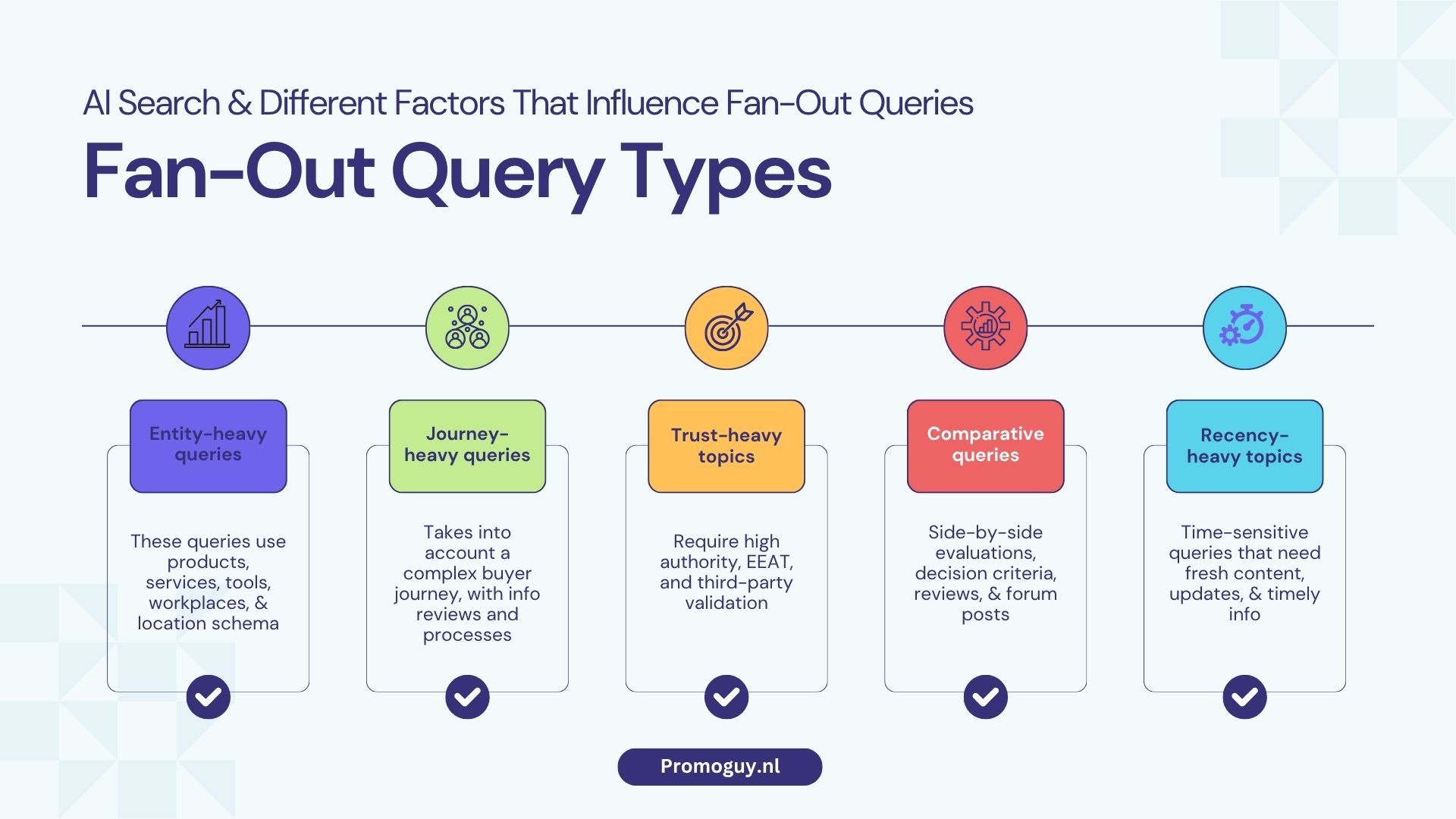
Different topics have different types of approaches that trigger them. Here’s a breakdown of prominent ones:
- Entity-heavy: Searches for products, services, tools, workplaces, locations, etc. These query search optimisations require working on structured data, maps, review sites like Yelp, business registries, and similar explicit attributes.
- Journey-heavy: This one applies to complex purchases and multi-stage decisions where, for example, installation might be expensive or require considerable thought. If you’re buying a new heating or HVAC system, AI will try to break it down into calculations, prices, what types of homes it will work with, energy standards, government grants, etc. Content that covers these different clusters will all be relevant.
- Trust-heavy: Controversial topics, high-cost items, and irreversible decisions require high authority, EEAT, and third-party validation. Financial topics, legal advice, psychiatric, and medical information all have a higher bar to clear. These will emphasise credentials, certifications, client reviews, regulatory compliance, .org URLs, and government sources.
- Comparative: Side-by-side evaluations and decision criteria are emphasised in comparative queries. It will put multiple reviews together or look for similar comparisons on forums and Reddit threads.
- Personalised: These queries may look for locational data or sites that match the prior preferences of certain users. Location data will be more important here. LLM-powered search keeps a log of what the user likes, so you cannot plan for this unless you are leaning into specific user niches.
- Recent: Time-sensitive queries are most relevant here. Focus on keeping fresh content, content with strong indications of time-dependence. Recent updates and current best practices make these easier to find.
How to Optimise Customer Journey Gaps for AI
An LLM search engine takes a lot of disparate information into account. This is why you need to cover a wide span of data.
- Optimise product pages: Add accurate descriptions, images, and details of relevant features.
- Optimise images: Add specific mentions of features and attributes. For example, add the product name you think people will search for with a brand name, and describe it properly in the alt text.
- Optimise your tags and categories: Include high-priority attributes of your products. List colours, reasons for buying them, prices, etc.
- Create relevant collection pages: Additional content that helps give more corroborating information about your products. This will help boost your product over others.
- Add relevant product schema: Add all the technical specifications of your product or relevant features and attributes.
- Check your commercial data and product feeds: Make sure the properties, features, and attributes of your product accurately portray your product and are relevant.
How to Track Performance for Query Fan-Out Optimisation
Use SEMRush or Ahrefs for tracking your regular SEO. Add in the priority fan-out queries that have more search potential alongside your main keywords and use tags to group related queries by topic cluster. This new list can help aggregate performance across, taking the bigger picture into account. You may also want to increase focus on synonyms and related terms that seem similar, or you would like to capture. With AI search, you can cast a wider net.
There are software applications like Brand Radar that aid in monitoring when and how your brand gets cited. It can measure stats across ChatGPT, Perplexity, Google AI features, etc. These are especially helpful for fan-out queries because you may never know when your company is being mentioned, as it can be less predictable. Check which searches you pop up in and reiterate on those related terms you may not have considered. Lean into them, add them to your webpages, and check if it improves AI and regular search numbers.
You should also set up measuring and portfolios with topic clusters. Many websites already do this, but with AI, this may have to become a standard SEO tactic. You can track aggregate metrics and see whether your approach is improving visibility across the entire topic rather than specific pages. You can draw topic clusters on different SEO tools.
While all the standard SEO metrics are still applicable, you need to gear them towards different types of queries, as discussed above. Focus on schema optimisation for businesses, locations, recipes, fixed prices, and other schema-sensitive topics. Focus on updating data often for time-sensitive queries. Similarly, authority scores are more important than ever.
If you’re looking for content that drives AI search results, check out our marketing services. We build an end-to-end workflow to optimise reach so you can sit back and watch the numbers roll in.