


Hashtags: Are They Still Useful in Content? (& Other FAQs)
Hashtags have been around long enough that many are wondering whether they are still useful. They go in and out of popularity, which is why we’re answering the latest findings on their effectiveness, which tools you can use to find them, and which platforms reward them the most. First, let’s discuss what they are.
The Short Version
In terms of how to use hashtags effectively, here are a few tips:
- Use them sparingly on most platforms.
- They are effective on Twitter, Instagram, and TikTok.
- They are mainly for contextualising the content rather than boosting it.
- Keep it between 3 and 10 hashtags.
- Use keyword-rich hashtags.
- Hootsuite, Later, and Talkwalker are among the best tools for analysing ideal keywords to tag.
What is a hashtag?
Hashtags are words or phrases preceded by a “#” symbol, allowing users to categorise them by topic or include them in trends. They help platforms learn what a post is about and make it easier for algorithms to sort them. These can be great for categorising posts for easier search, starting off trends, and creating an easy way to track campaigns.
For example, if you create a campaign around a hashtag like #lazyweekends, others can join in on that topic and interpret it as a writing prompt. They may share their stories on that topic or find ways to get creative with the keywords. It can create a cloud of associations on a very specific topic, while also providing an easy way to analyse reach.
Hashtags were used extensively on Twitter back in the day, and have been part of the lingua franca of Web 2.0 since its heyday. They’ve been incorporated into TikTok and Instagram Reels, but are not considered essential. In fact, a lot of modern content does just fine without them fairly often.
So, are hashtags still a thing worth investing time in?
Are hashtags still relevant?
Yes, hashtags are still handy. While they are not front-and-centre in terms of importance, they are a great additional signal for topic categorisation. It can be great for nudging the algorithm in the right direction. The tags that tend to work best follow niche, relevant, and community-oriented topics. These can receive a significant boost from the inclusion of the right keywords and allow others to chime in. Platforms emphasise signals like viewer retention, saves/shares, comments, and watch time over the presence of hashtags.
However, that doesn’t mean they aren’t a signal as well. Added to the rest of these, they can be a nice assurance that a post will be received as intended.
Let’s break it down by different platforms and sites:
Do hashtags work on Instagram?
Yes. Many social media experts argue that Instagram users are the most prolific hashtag users. This bolsters your post but is not effective on its own. It’s a better use of time to aim for keyword-rich captions, alt text, and on-screen text, especially on Reels. It may be the best way to optimise everything together.
It’s important to keep in mind that hashtags can be an impediment when they are NSFW or subject to shadowbanning. Not all of these are controversial words, either. On Twitter (now X), your post reach will be limited for a number of reasons, such as adding a hashtag with a competing social media platform’s name. Similarly, Instagram will shadowban #snapchat.
Make sure the tag you have is not banned. It can be on a banned list online, or you can check how much reach a keyword has before you post it. Check whether it has some sway online and whether others are using it.
How many hashtags should I use on Instagram?
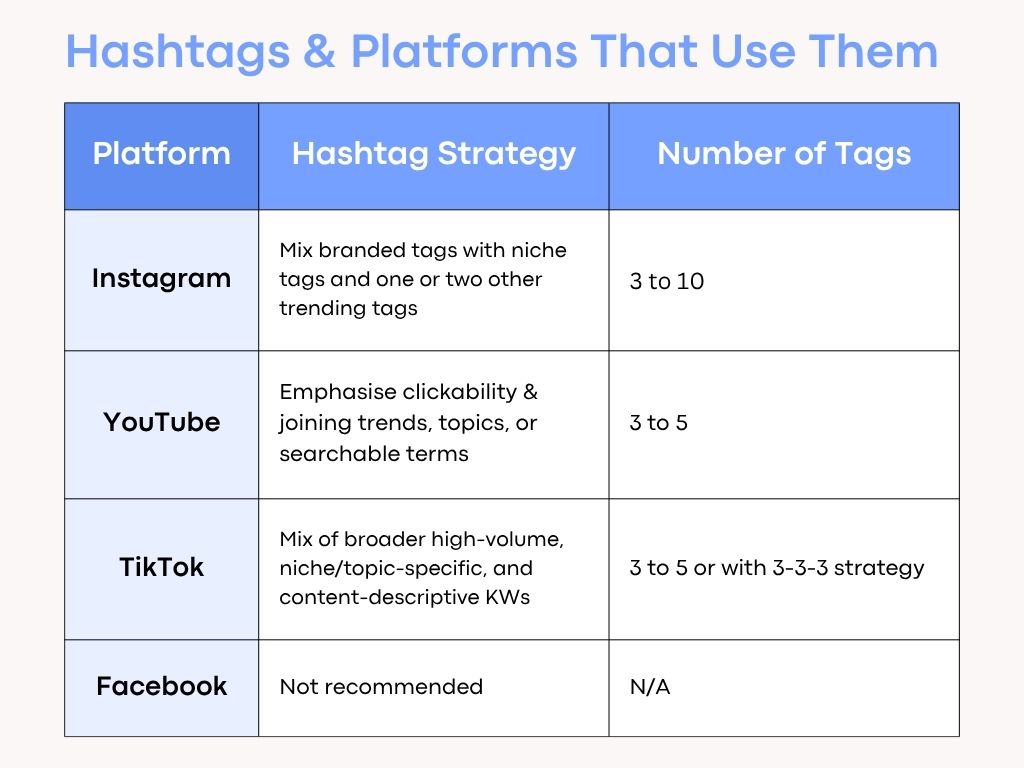
You should use 3 to 10 targeted hashtags per post. You can place them at the end of the caption or put them in the first comment. Here’s more about how to use hashtags on Instagram:
- Use 3 to 10 (ideally around 5) relevant keywords.
- Avoid random ones that do not relate to the topic (it will seem desperate and derank your content).
- It’s best to mix branded tags with niche tags and one or two trending tags.
- You can put them in either the caption or in the first comment for maximum effect.
- Instagram may flag spammy tagging if you reuse the same keywords over and over.
- You should avoid banned or generic ones.
Should I use hashtags for YouTube?
Yes. According to YouTube, hashtags are useful. They link your video to other similar tags in other videos, and they make specific keyword signals much stronger. There are a number of tools online that can help find up-to-date keywords you can employ in your videos to get them trending or even viral.
You can add keywords with tags to video descriptions or titles. Both of these are clickable and allow the platform to engage in a search for similar videos. It’s best to make sure you’re using the right keywords, unless you want to lump your videos in with unrelated ones. It’s best to keep these to a maximum of 3 hashtags.
How many hashtags can you have on a YouTube short?
You should use up to 3 to 5 hashtags for a YouTube Short. You can use up to 60, but you should absolutely not use that many. YouTube will ignore them if you over-optimise on keywords, considering your content spammy.
How many hashtags should I use on TikTok?
TikTok videos work best with 3 to 5 hashtags, according to data from CapCut. Keeping the hashtags focused on a singular topic is also necessary. Simply adding disparate subjects as keywords will confuse the algorithm and be less effective for users who are actively searching for content.
Some marketers have highlighted that a “3-3-3” strategy can allow you to use up to 9 hashtags with no penalty. Here’s how the strategy works:
- 3 Broad or high-volume hashtags: This could be things like #fyp or #trends
- 3 niche or community-focused hashtags: This would be more specific to certain niches, like #marketing or #wintersports
- 3 Content-specific hashtags: Content-specific hashtags would be specifically about what is in the video, like #webdesignideas
Do hashtags work on TikTok?
Yes. Hashtags will boost visibility, increase engagement, add your video to trends, and support the algorithm in tagging things properly. It’s best to focus on trending topics and integrate them into the video.
Do hashtags work on Facebook?
While you can use them, they are not recommended. It can decrease readability and will be less effective. Generally, they are not commonly employed by users either. This can be an indication that adding them may put them out of step with the style of the platform.
Best Research Tools
Here are some of the best hashtag research tools:
- Hootsuite Analytics: The trending hashtag breakdowns allow you to monitor which hashtags are performing best in your chosen topics. Analyse the hashtags your competitors are targeting to see which drove the most comments, reactions, shares, likes, and estimated engagement. Alongside the publishing capabilities, Hootsuite can be a powerful tool.
- Talkwalker: Aside from hashtag tracking tools for Instagram, Facebook, and Twitter, there are seven other social media platforms. It also provides insight into websites, blogs, and forums, making it a comprehensive platform. Derive information for important hashtag metrics like brand mentions, engagement, reach, and sentiment. Create better graphs for reporting, which will help you understand which keyphrases and new trends are emerging on the scene.
- Later: Later’s tag-finding tools are laser-focused on Instagram, which can be great for some users. They offer good hashtag analytics that can track and analyse which ones lead to the most likes, comments, saves, and reach.
- TikTok Creative Center: This is a free tool that displays the most popular, trending hashtags in real time. It allows you to separate these by country or category so you can find the most effective ones for your campaign. It is instantly updated so the trends are fresh, allowing for optimal engagement.