



Outdated SEO Tactics: Which Practices to Avoid
SEO is an ever-changing set of practices that often shifts with the whims of Google’s algorithm. The problem with this is that we have to adjust our perspective and relearn every once in a while. Let’s go over some common tricks and see if these are valid or outdated SEO practices.
FAQ Schema
One of the big recent changes to Google’s policy towards FAQ schema means that the algorithm will only focus on official, high-quality domains. Unfortunately, this means that a lot of the schema we use to get handy content in the “people also ask section” may not be interpreted by Google. That spot is now reserved for official and government websites.
However, this doesn’t mean that we should stop using it completely. It is still important for AI search, as some sources indicate that FAQ schema is crucial for AI detection. The way AI picks up certain information vs others increases visibility on text with the schema, despite its lack of importance to Google.
It is also great for formatting. Elements like accordions can be a handy way to put in non-schema-formatted questions in dropdowns, where they won’t clog the pages with extra information. They can also still attract clicks if they answer user queries, even if they won’t show up in the optimal places on the SERP.
A similar discussion is happening around alt text and descriptions for images. While image recognition has gotten a lot better, search engines still rely on alt text, allowing images with it to trump ones without. All in all, despite the automation of these elements, they may still give you a leg up.
Avoid Outdated SEO Formatting
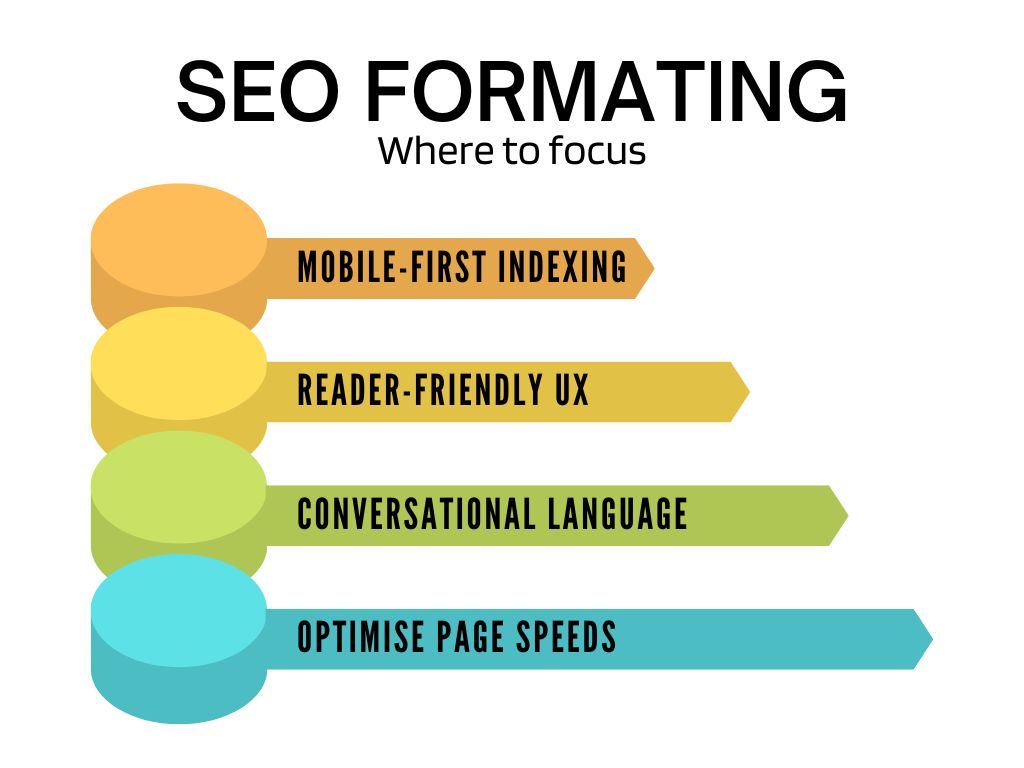
Throughout the years, we have accrued a bunch of SEO formatting techniques that are no longer relevant. As Google has begun focusing on readability, the following tips are more useful:
- Mobile-first indexing is key: Since 2015, Google has been prioritising mobile-friendly design. This often means that adjusting for mobile viewing is key for the search engine. While any page needs to look great on both mobile and PC, mobile optimisation shows an extra level of care, and neglecting it is a bad signal for Google.
- User experience is more important than ever: Focus more on smooth page-reading, avoid unnecessary elements that clog the page before the user gets to the actual meat of the article. This can damage time on page stats, exit rates, and bounce rates. What you need most of all is good UX that guides users to the sections most relevant to their query.
- SEO language vs. conversational language: It’s fine to get your SEO keywords and phrases in there, but more conversational styles of writing can be better. As search engines try to crack down on spammy, low-effort AI content, it can be helpful to write in a natural voice. Similarly, voice search is making conversational language far more effective.
- Don’t overload pages: For about a decade, websites have been getting bulkier. SEO specialists have been hoping to cram in as many SEO elements as possible, using accordions, images, animations, and heavy components. While these can be great for the page in moderation, they risk slowing down the page. Pages that load fast are prioritised by Google, as they are more user-friendly. Focus on page speeds and helpful formatting for the readers.
Formatting is becoming more important for search engines. It not only improves reader metrics, but it also helps AI find pages. While targeted keywords are still important, readability and precision of language are higher on the totem pole.
Are Metadescriptions Worth the SEO Value?
Recently, many SEO specialists have been debating whether metadescriptions are worth it. Since Google often rewrites the whole entry seen on the SERP, some argue that there is no need to enter one at all. From our perspective, the answer is somewhere in the middle.
A metadescription can be handy in summarising a page, but since Google often ignores it to focus on parts of the article, it may not be worth the trouble. However, writing one doesn’t always take much time, and if your page contains crucial info that might be best summarised on the SERP before readers click, you may want to go ahead. For example, it may be best to add it to short pages like service or contact pages and other functional website elements. These need a clear copy to outline their function and thus benefit from the meta description.
For certain pages, it may not be the best strategy to incorporate them. If you have a page with a lot of search terms, Google will probably take out the snippets that involve that term. Some researchers have indicated that Google will replace 70% of meta descriptions. However, this can be beneficial, as the replaced metas tend to target search terms more clearly. In these cases, why bother?
Ultimately, it depends on a case-by-case basis. You should definitely consider whether your page can be summarised in a short description or whether it can benefit from an autogenerated one. The latter situation can depend on how likely it is that some section of the text might be picked up by Google. Articles that cover different topics that are hard to summarise, but with varying SEO phrases, might be better off without one.
Linkstuffing is Bad SEO
Prioritising the quantity of backlinks can be detrimental to your website. Focus instead on quality, and make an effort to get the right websites to link back to you. This means look for pages with high domain rankings, “org” or “gov” URLs, and have high shareability. Linkstuffing has been deemed bad due to its misuse by bad sources.
Large-scale guest-posting and using giant link directories are thus outdated. Instead, SEO specialists should look to provide information to official sources and link their information in them. This can be in the form of newspapers, research journals, or government websites.
As far as we can tell, internal linking works the same way. While it can’t add to URL rankings, it can still be beneficial in pointing Google in the right direction. Pay attention to keyphrases you internal link to and make sure you match the search intent accordingly.
If your company needs help with SEO, why not check out our SEO services page? We provide everything from audits to content to monitoring and evaluation.