


Social Media Usage Stats to Keep in Mind For 2026
Social media usage tends to shift each year slightly, showcasing how different demographics are using platforms. The lifespan of a platform is dependent on how it can maintain metrics, including overall users, time spent on the app or website, and various demographic factors. We examined the most recent social media usage datasets released by the PEW Research Centre and other sources. Here’s what we learned:
Social Media Usage Stats Reveal Winners & Losers in 2026
The top 10 social media websites in terms of user share include:
- YouTube: 84%
- Facebook: 71%
- Instagram: 50%
- TikTok: 37%
- WhatsApp: 32%
- Reddit: 20%
- Snapchat: 25%
- X: 21%
- Threads: 8%
- Bluesky: 4%
This social media website list is derived from PEW’s end-of-2025 study and deals primarily with US audiences. However, trends in the rest of the world are not far off.
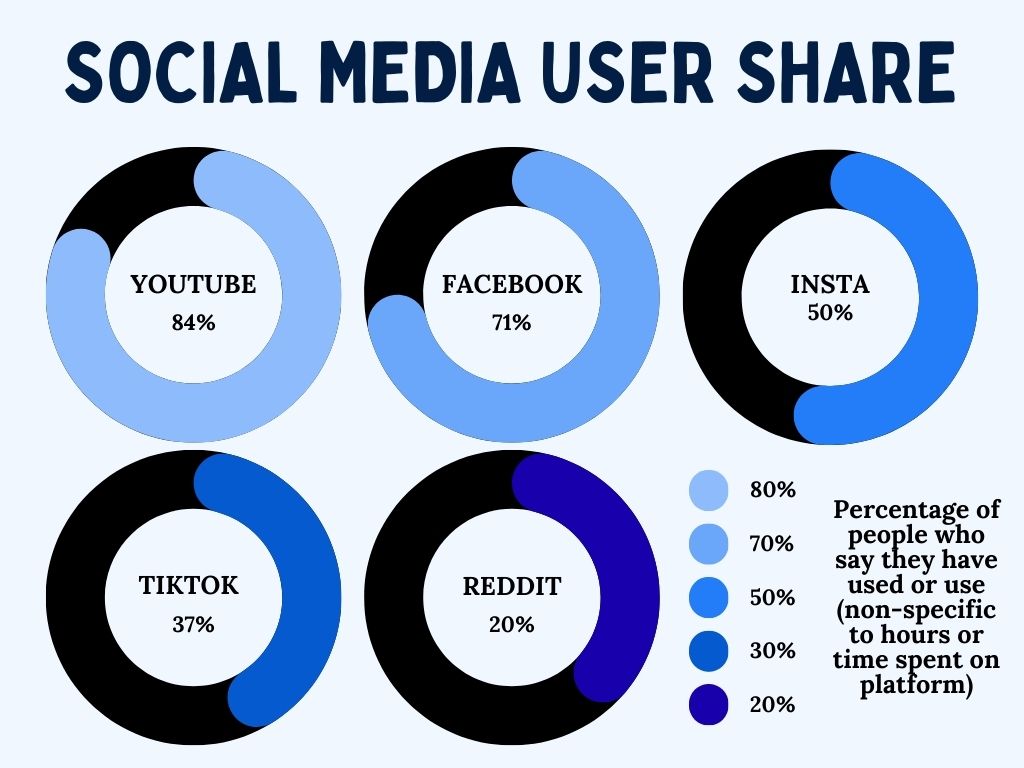
The most popular social media apps tend to be more visual and offer multifunctionality (messaging, video calls, etc.). Age-based demographic drift has also been a factor in the change from year to year, with TikTok being a relatively young platform. Relatively new social media apps like Threads and Bluesky are not seeing the rate of growth that TikTok saw, but are also niche in terms of their functionality (both being microblogging platforms) and demographics (splitting the audience from Twitter/X).
The social media with the most users is still Facebook; however, it has had decreasing time per user for many years.
Nature & Purpose of Social Media Usage
The most common social media apps are Facebook, YouTube, and Instagram, with TikTok accelerating rapidly. People use these websites and social media apps for multiple different reasons:
- Keeping in touch with family and friends: 50.8%
- Filling spare time: 39.0%
- Reading news stories: 34.5%
- Finding content: 29.2%
- Seeing what’s being talked about: 27.3%
- Finding products to purchase: 27.2%
- Finding inspiration for things to do or buy: 23.6%
- Watching or following sports: 23.4%
- Watching livestreams: 22.5%
- Seeing content from your favourite brands: 22.1%
Similarly, most users tend to primarily follow friends and family (48.8% of users), entertainers/actors/celebrities’ accounts, (28.5%), and comedy or satire accounts (27.5%).
Social Media Usage Frequency
On a per-user basis, Nigeria, Canada, and France have high hourly social media usage in terms of average hours per day. These countries are thus also high MROI (marketing return on investment) regions. However, these are also regions (aside from Canada) that consume content and ads in their own specific languages, which can be a double-edged sword for international products.
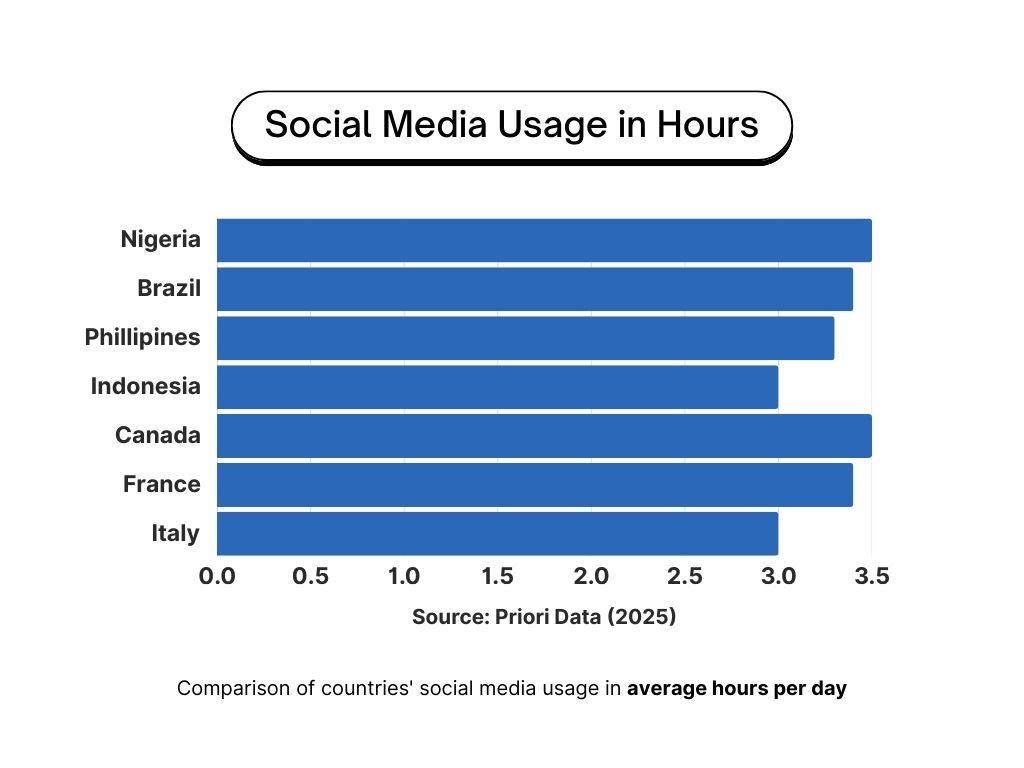
This should also be contrasted with the countries that have the highest number of users in general. As one might expect, those numbers match more or less with the highest populations (China, India, the US, and Brazil topping the bill). Putting both these datapoints together, Brazil has the highest number of “power users” who spend an inordinate amount of time on social media. Another good candidate is Indonesia, which boasts a high population and many high-frequency social media users.
The numbers also show very few differences in gender when it comes to the biggest platforms. Certain niche platforms, like Pinterest, have a more pronounced female following, while X has been losing female followers in recent years. Broadly, most dominant platforms have a good mix of demographics.
What Social Media do Teens Use
The stats above have largely talked about adults (or teens that are 16+), but younger users have differences in tastes. Here are the stats on the most popular social media apps for teens, according to PEW Research’s findings on teen social media trends:
- YouTube: 93%
- Snapchat: 60%
- Instagram: 59%
- TikTok: 63%
- Roblox: 60%
Out of all the kids’ social media apps and other social media websites, Roblox is the standout. As a platform, it has broken through with a unique user base and functionality.
Gen Z social media usage is far more visual-based than even that of previous generations. While micro-blogging and text-heavy platforms show up a lot more with older demographics, short-form video and gaming are dominating for teens. The most popular social media apps for teens include YouTube, TikTok, and Instagram, all of which feature ephemeral, short video features.
Similarly, usage frequency also shows that there are some severe generational differences with Gen-Z and Gen Alpha:
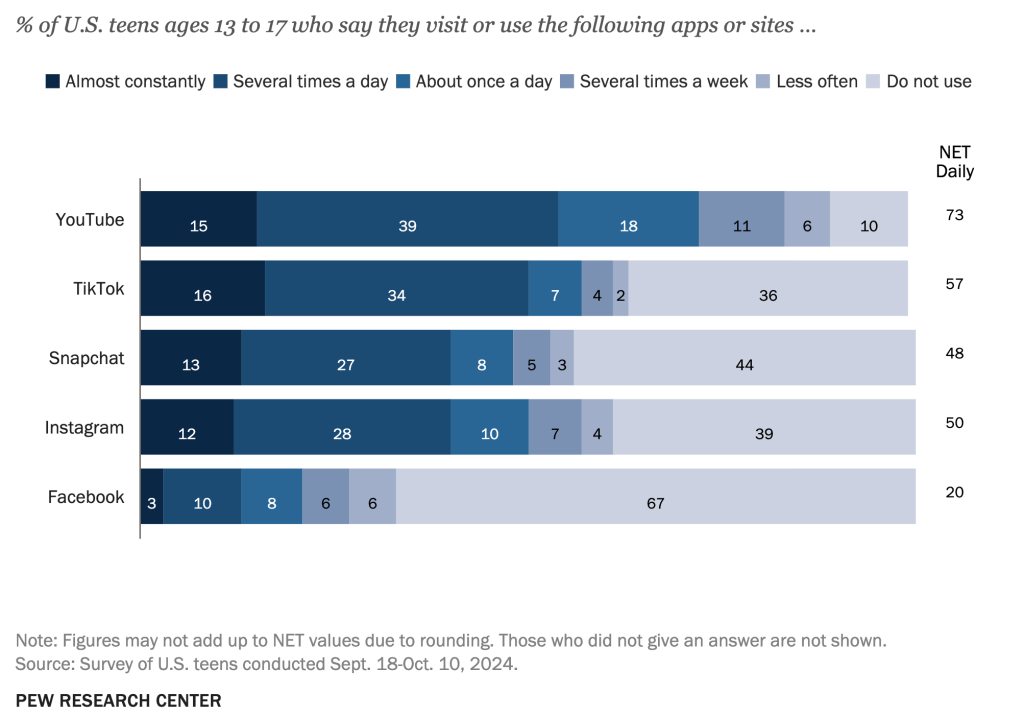
As the data shows, Facebook is in dire straits with teens in the US. YouTube and TikTok have the most ardent teen users, many of whom report constant usage or usage several times a day (54% for YouTube and 50% for TikTok). In comparison, 67% report that they do not use Facebook at all.
Snapchat is still running strong among younger users, while Instagram might be the Meta platform with best age demographic spread. It’s also worth noting that TikTok has spread out as well, and might be the one with the most dedicated users, while not yet being quite the size of some of its contemporaries.
Adult Social Media Users Divided by Age
The differences in how different age demographics use social media are also instructive. YouTube is fairly ubiquitous across all age groups, tapering off a little among the 65+ demographic.
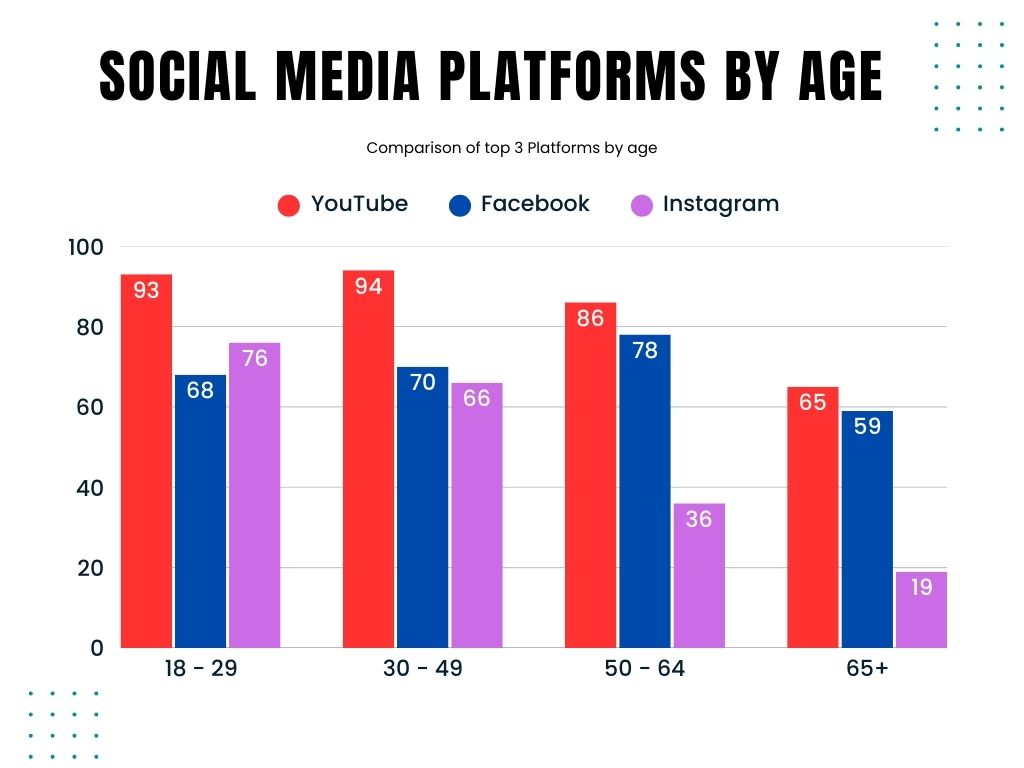
- 18-29 years – YouTube (93%), Instagram (76%), Facebook (68%), Snapchat (65%)
- 30-49 years – YouTube (94%), Facebook (78%), Instagram (66%), Pinterest (43%)
- 50-64 years – YouTube (86%), Facebook (70%), Instagram (36%), LinkedIn (30%)
- 65+ – YouTube (65%), Facebook (59%), Pinterest (22%), Instagram (19%)
As the data shows, Facebook is losing younger audiences. Social media apps for adults (or those geared primarily towards millennials and Gen-X) are not growing at the same pace among the youth. YouTube remains a strong contender in many different age groups, while Instagram is still by and large young people.
Some of these findings make sense upon closer examination. Retirees are less likely to use LinkedIn and may not be as interested in visual platforms like Instagram. The use of YouTube has become even more ubiquitous due to the podcast boom that happened in the past years. Many people tune into long-form videos and leave them on in the background while working or doing chores. In this sense, YouTube can be more functional than other social platforms.
Relevant Social Media Trends for 2026
Social media is still strong in 2025 and shows no signs of slowing down in 2026. However, there are differences in usage and expectations over time.
Video Remains the Biggest Draw
Visual media is the most eye-catching form of content. Videos and pictures instantly get the point across in advertising, and long-form media like podcasts provide a lot of ad space for marketing campaigns. It’s why YouTube has been pivoting to longer videos. However, video can also be more expensive and time-consuming to put out, so make sure you’re working with the right medium with the highest ROI.
Aside from videos, thumbnail trends still indicate that faces, bright colours, and text that adds extra details about the topic of the content. It’s simple: if there is a video that can give more context quickly or put in a hook more effectively, viewers will go for it instead.
Serialised Content is Getting Bigger
Whether we’re talking about podcasts, video series, or simply ads that invoke a connected structure, consumers are tuning in to content that has them coming back. Content that is connected to a wider series is not just good for giving more to customers; it can also be good SEO. Since algorithms take into account what people watch right after they’ve consumed one piece of content, it can give a boost to the next instalment of a series.
There is evidence for this in the growth of TikToks that have a “pt.1″ and then”pt.2” and so on. This allows readers to return to recurring themes and instantly gravitate towards a familiar format if they enjoyed it previously. If social media users have the choice between something familiar and something fresh, they are going to go for the familiar (in most cases).
AI is a Double-Edged Sword
AI content has gotten better, with many users softening up to its use, but there are still hurdles. Many users are resistant to it or will resent brands for using it to promote their products. Many users find branded AI content to be a turn-off. It also makes companies seem cheaper to certain audiences or may give the impression that the product descriptions and marketing materials are misleading.
Another reason that AI should be used carefully is that people are expecting more authentic content, while AI can indicate the opposite. While it’s cheap and can be effective if deployed well, there are plagiarism hazards. Many companies have inadvertently copied content from photographers and influencers due to AI models not deviating the output enough from the training data.
This is not to say AI has no uses. Streamlining content creation with AI can save time in many situations. Creating high-quality outputs has never been easier. However, people tend to have an adverse reaction if they can clearly see AI artefacts (and may even imagine AI artefacts where none exist). This is also why it’s important to be transparent about AI use to build trust, lest your audience feel like they are being deceived.
Don’t Count Out Social Search
While SEO is great and all, there is a growing number of users who tend to use social media as a search engine. Social search is where optimising for pick up on social media comes in. Every platform works differently, and it can be a fool’s errand to optimise for every single one, but if you know your audience and where they might search for you, investing in social search may pay off.
Popular social media platforms provide great opportunities for easy social search, especially if you’re already uploading to them. Many users will check on YouTube rather than Google, especially when it comes to visual or audio tech (like musical instruments or cameras), where the video presentation adds a lot more. These first searches can be a great way to focus on early stages of the funnel that indicate interest and intent to buy.
If you’re looking for social media services, we can help you out. Our work includes consulting, discovery, analysis, and content creation. Check out our marketing services page to learn more.