


Real-Time Marketing 101 For Online Businesses
While many types of marketing and promotion can be glacial and bureaucratic in their nature, there are many benefits to the opposite approach. That’s where real-time marketing comes in, providing quick and hyper-specific marketing efforts that adjust as quickly as possible. This is an agile approach to promotion with flexible operations that shift with new incoming information at rapid speeds.
Let’s look at what this style of marketing has to offer, what principles drive it, and how companies have used it to their advantage.
What is Real-Time Marketing?
Real-time marketing utilises instant data collection to build fast and robust marketing responses, taking a particular situation into account and responding quickly. This makes it low on bureaucracy and very contextual, but it helps strike while the iron is hot rather than getting bogged down by meetings and extensive iteration. It can thus be a double-edged sword since it operates on speed over careful, deliberate decision-making.
However, it can also be effective for this reason, providing timely responses to information. As a result, it is dependent on robust data-gathering processes. It can be effective for social media marketing or remarketing, as it is a fast-paced endeavour that also enables quick data collection and timed responses (not always instant, but definitely quick). This is why real-time marketing goes hand-in-hand with analytics, automation, and instant forms of communication.
For example, real-time customer marketing can involve things like remarketing campaigns that quickly analyse website behaviour. An automated system can send a visitor a reminder email or similar product suggestions. The data is gathered instantly, while the system decides to send them a reminder or sales-pushing CTA at an opportune moment. It’s important to note that this does not necessarily mean it should go out to the customer instantly, as that might not be the best moment for conversion.
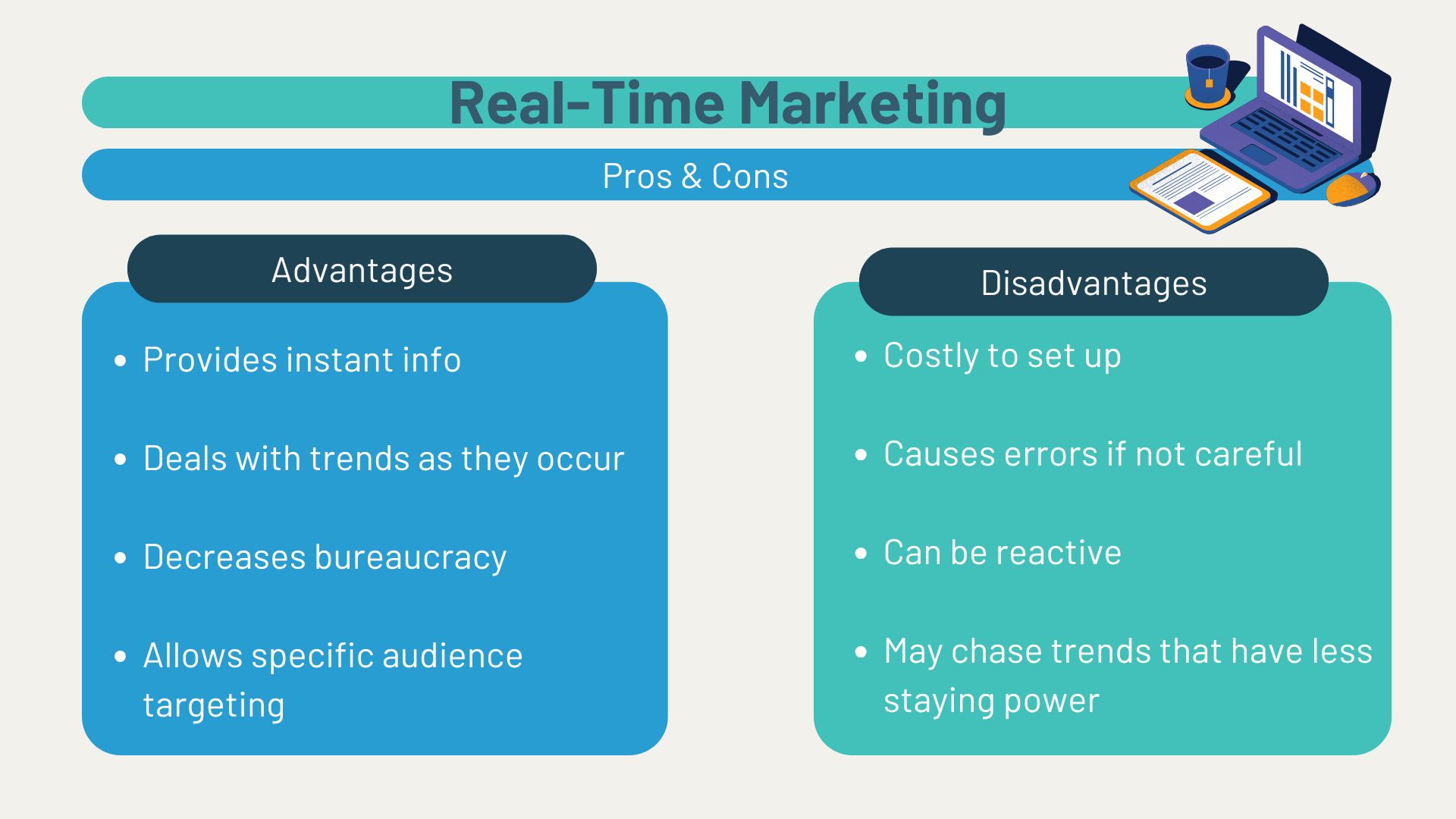
There are many benefits you can target with real-time data collection, but it’s worth noticing that it is expensive to set up. Another downside is a higher potential for errors, as real-time marketing has fewer checks. However, a well-organised information system can reap massive rewards.
Real-Time Marketing Mix
Any real-time marketing mix modelling has to account for numerous points to properly
- Continuously gathering the freshest data and automating its intake.
- Leveraging marketing tools like continuous monitoring, automation, AI, and Machine Learning for quality checks to spot errors and outliers.
- Rapidly refreshing models with the newest data.
- Automating reports and insights via NLP and NLG technologies.
- Delivering businesses transparent, self-service access to Marketing Mix Modelling through user-friendly interfaces and simplified tools.
In terms of the marketing mix itself, real-time marketing presents many opportunities:
- Prices can be adjusted on the fly, taking instant information into account. Dynamic pricing can be an example of this, with the exact temporary status of customers being taken into account.
- Products can adjust how they function to account for changes in consumer behaviour, for example, SaaS tools adjusting to behaviour. Data can come in and allow for adjusted packages that suit how the customer wishes to use the product. This can also serve as a way to offer better deals and customisation.
- Promotion is also dynamic and fluid. As cookies and behavioural data are assembled, marketers and autonomous programs can adjust their approach to marketing.
Real-Time Processing
Developing a real-time process monitoring requires quite a few different tools and modes of data collection. Not all of these need to be implemented together, but many might be useful to your specific business.
- Variance Analysis: Generate Due-To reports to instantly analyse variance in sales, providing a better understanding of the ebbs and flows of revenue. Any variance analysis should look at how different activities contribute to marketing spend, bringing together as close to a cause-based reporting as possible.
- Campaign and Promotions Analysis: Evaluate marketing and promotional campaigns to determine the winners and losers. Track promotions to find the ones that contribute properly and iterate on them as they go on, much like on Google Ads.
- Simulation Analysis: Run simulations on your marketing budgets, adjusting spends to evaluate the impact on revenues. Adjust the simulations in real-time to test out changes before implementing them.
- Optimisation Analysis: An optimisation analysis recommends the optimal marketing allocations to build towards the best sales and revenue plan within your budget.
- Marketing Budget Reallocations: With the real-time data, you can reassign remaining marketing budgets more quickly. These processes can be more agile and make small changes for quick impacts. Real-time marketing spend data by channel sources should be comprehensive so it doesn’t lead to unjustified conclusions.
- Real-Time Performance Tracking & Gap Analysis: They repeat the process again in a month to track actual performance versus forecast in real-time and take ongoing corrective actions to bridge any gaps and achieve their targets.
Real-Time Customer Data Platforms
Real-time data processing tools are crucial for setting up your marketing procedures and ensuring they run properly. Here are some commerce tools that can help.
- Salesforce Customer Data Platform (CDP): Best for cross-channel marketing. For enabling real-time unification, segmentation, and activation. Pricing available on request.
- Microsoft Dynamics 365 Customer Insights: Best for real-time intelligence. To build rich, multi-dimensional profiles and activate them in real-time. It costs about $1700/month to run.
- SAP Customer Data Platform: Best for predictive modelling. To enrich profiles and run predictive analytics across data teams. It costs $1236 per month to run.
- Treasure Data CDP: Best for dynamic segmentation and journey reporting. For orchestration, real-time segmentation, and audience analytics. Pricing available on request.
While the tools above are far more suitable for commerce data, there are others that can provide great social media analytics in real-time. Here are a few:
- Keyhole: A real-time social media analytics tool, which is great for live hashtag tracking and social media monitoring. It can track on multiple social media networks, including X, Instagram, and Facebook. Ideal for social media marketers and brand managers who need a leg up in tracking campaign performance or influencer projects. You can measure your post reach and analyse audience engagement, view and analyse conversations, monitor your brand’s mentions, and even judge customer sentiment. It can be especially handy for detecting and responding to reputational risks in real time.
- Brand24: Offers AI plugins that allow you to analyse social media metrics and derive social media statistics. It can also help evaluate the performance of your target keywords on Facebook, Twitter, Instagram, TikTok, and YouTube. Offers statistics like mention volume, social media reach, and sentiment analysis in real time. Discover trending hashtags and identify what’s making waves in your niche, so you can instantly put out responsive content. To this end, it can help you find out how often hashtags are applied to a topic and the level of awareness they generate. You can also compare your performance against that of your competitors.
Real-Time Marketing Examples
Here are some real-time marketing examples that can help illustrate the value and procedures that make it a mainstay for many companies:
ME’s Real-time Content Marketing Strategy
Maximum Effort is a marketing firm founded by actor Ryan Reynolds, which provides many great examples of real-time content creation. The company’s entire business model is to find breaking news stories or business news and capitalise on them within hours. This often involves creating a full ad production and launching it to go viral within the timeframe where the story is still fresh.
For example, in December 2021, in response to the TV series “And Just Like That…”, a character named Mr. Big dies on a Peloton bike. This caused shares in Peloton to fall due to a vague perception of them being associated with unhealthy exercise. Maximum Effort quickly pitched, shot, and edited an advertisement for Peloton, and Reynolds provided the voiceover promoting the health benefits of cycling. The ad provided a comedic counterpoint for Peloton and became more popular than the event that inspired it.
Calm’s Counterintuitive Ad Strategy
During the 2024 US Elections, California-based software company Calm found an opening in a noise-cluttered field. The constant stream of breaking news was flooding everyone’s screens, with flashing images, and apocalyptic, divisive data putting people off. In keeping with their mission, the company’s mindfulness app “Calm” found a way to do an effective marketing stunt.
In response to some very frantic updates and particularly harrowing content, they aired 30-second silent ads with minimalist text and calming textures. Utilising animations of rain clouds or breathing exercises, they would ask the viewer to take a break. The text reads “We bought this ad space to give you 30 seconds of silence”. It served as a well-needed respite based on a change in how everyone else’s ads were influencing the mindstate of the viewer. Utilising well-targeted search and YouTube ads that found the audience that needed a break, they created an effective campaing.
IKEA Seizes on a Viral Moment

Superstar footballer Cristiano Ronaldo struck Internet virality gold during the 2020 Euro Press Conference. As one of the world’s most famous personalities, Ronaldo appeared annoyed at the presence of a few bottles of Coca-Cola at the conference, moving them out of the frame and exclaiming his lack of interest in wasteful plastic. He raised a glass bottle of water instead, and shouted “Agua” in response.
IKEA Canada noticed the moment and, within a day, they renamed their KORKEN water bottle “CRISTIANO”. They posted it on social media and captioned it “Reusable bottle for water only.” This moment instantly built on top of prior viral momentum to capitalise on a moment that speaks to a broad audience.