



Long-Form Content: Ideal Content Length, SEO, & Promotion Tips
While long-form content has a lot of competitors, it still has a place in the content marketing pipeline. That said, it can be more time-consuming, so one should aim for ideal content lengths. We’ll discuss what long-form articles are, how long an article should be, and when it is appropriate to use longer content compared to short-form content.
What is Long-Form Content?
Long-form content refers to any piece of written work on the Internet that is roughly over 1500 words or videos that exceed 10 minutes. While many sources deviate on the exact length of written content (anywhere from 800 to 2000 gets cited as the minimum), 1500 is a good benchmark. In more practical terms, the minimum can shift based on the topic and the precise style of the page.
Long-form content is still crucial for SEO and other forms of organic marketing, as it allows for in-depth answers or deep dives into a topic. It can also veer into the realm of podcasts, which have become a crucial part of marketing for both marketing content and as vessels for sponsorships. Types of content can vary, since content is a diverse category. Here are some common types of long-form content:
- Articles or blog posts
- Podcasts
- Long-form video
- Landing pages
- White papers or e-Books
- Webinars
- Tutorials
- Case studies
Long-Form vs Short-Form Content
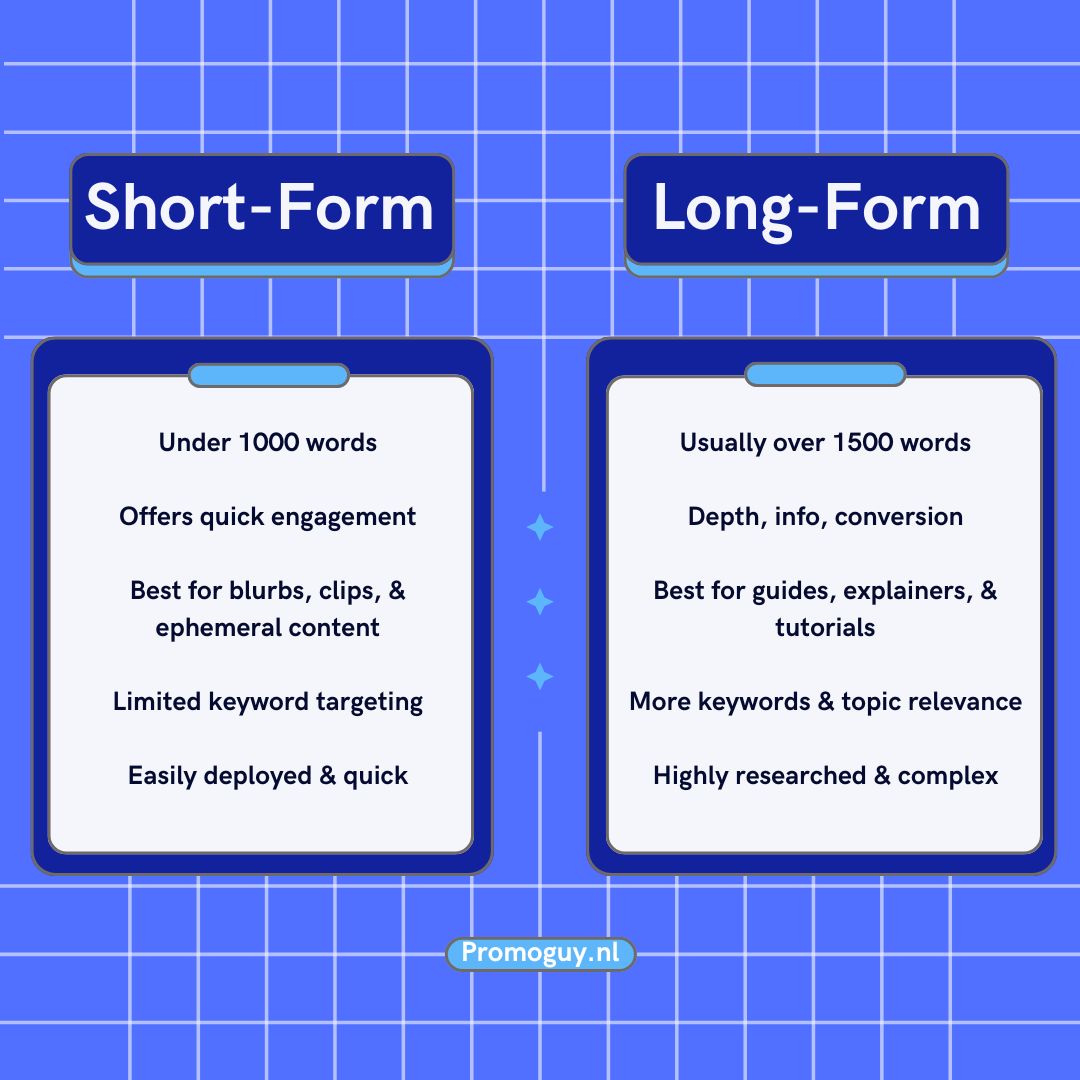
The choice between long-form and short-form is more about areas of effectiveness rather than which one is better. Neither option is intrinsically better because most of the time you will have to use them together. In fact, they are often symbiotic. For example, if you publish a podcast, you will have to promote it with Shorts, Reels, and TikToks. These will feed each other rather than being in opposition.
Long-form articles can be great for tutorials and walkthroughs for your products, while short-form can be great for individual query solving. Both have their own place. Generally, shorter content has wider appeal and transmissibility, while longer content provides more depth and engagement with the material. Think about the difference between a tweet that goes viral versus an article that fewer people read, but develop more of an attachment to.
In terms of practical differences, most longer-form content will be more difficult to produce than short-form content in general. Podcasts require more effort and time to film than YouTube Shorts, but this can vary on the ambition of the video. However, short-form content may not have the staying power or cover all the necessary bases the way longer pages or videos can. However, the lack of time investment in short-form content can more easily go viral.
Shorter content is also much more likely to get picked up by AI if that is a desirable goal for you. AI tends to have a small context window, which is decided by how many words it can gobble up within a timeframe. That makes shorter content that gets to the point more desirable. This is not to say that longer content will be entirely overlooked by AI. Well-formatted articles with proper headers can be easily crawled by an AI regardless of length.
How long should an article be?
So, how long should a blog post be to perform well? Generally, articles and blog posts should be between 1200 and 2000 words as a sweet spot. This changes constantly with every Google Core Update, general viewer trends, and the specific topic.
That said, you don’t have to blindly wonder how long a blog post is supposed to be if you have specific SEO tools like Ahrefs or SEMRush. Using the content analysis tools within these programs can give you a decent read-out of the average length. That said, one should not be beholden to them at the expense of one’s own style and readability standards.
From personal experience, longer work performs well. Long articles will generally be over 1500 words, but the upper limit is anyone’s guess, because often long-form writing has more space to address what people are Googling. Our best-performing pages tend to be 2,000 to 3,000 words or more. If you have the material, write more as long as it doesn’t get repetitive.
Similarly, shorter content can also serve its purpose. An exact query (like a question or topic that is easily answered) that can be handled with a shorter page should be kept brief. While longer pages do better with “time on page” metrics, shorter ones can still do better on CTR and shareability if they get to the point.
Long-Form Content SEO
When comparing short-form vs long-form content SEO, long-form comes out on top for a number of reasons. It allows for a deeper dive into the topic with more opportunities to naturally incorporate keywords. Time on page metrics can be better as well, as longer reads allow for better scores. Here’s how to make the most of these benefits:
- Add a proper structure, descriptive headings, proper answers underneath each section, and the right keywords.
- Add semantic depth by incorporating related terms, subtopics, and common follow-ups.
- Utilise proper readability standards with short paragraphs, lists, tables, jump links, and summaries. This makes the page easier to skim, as not all readers are there for a deep dive and may have more specific questions.
- Make sure you highlight the authority of the page and writer by including author credentials, first-hand examples, and reputable citations. Aside from being good for SEO, readers are more likely to stick around if the page seems credible.
- Optimise page speeds, mobile operation, and HTML structures.
- Use internal links and get external ones to make sure the page is part of a helpful topic cluster.
- Place keywords naturally in titles, headings, URLs, and meta descriptions.
Social Media Tips For Long-Form Engagement
There isn’t much long-form social media content out there, as social media relies on quick hits. However, that doesn’t mean social media can’t support your long-form content efforts. Social media platforms can be useful in the following ways:
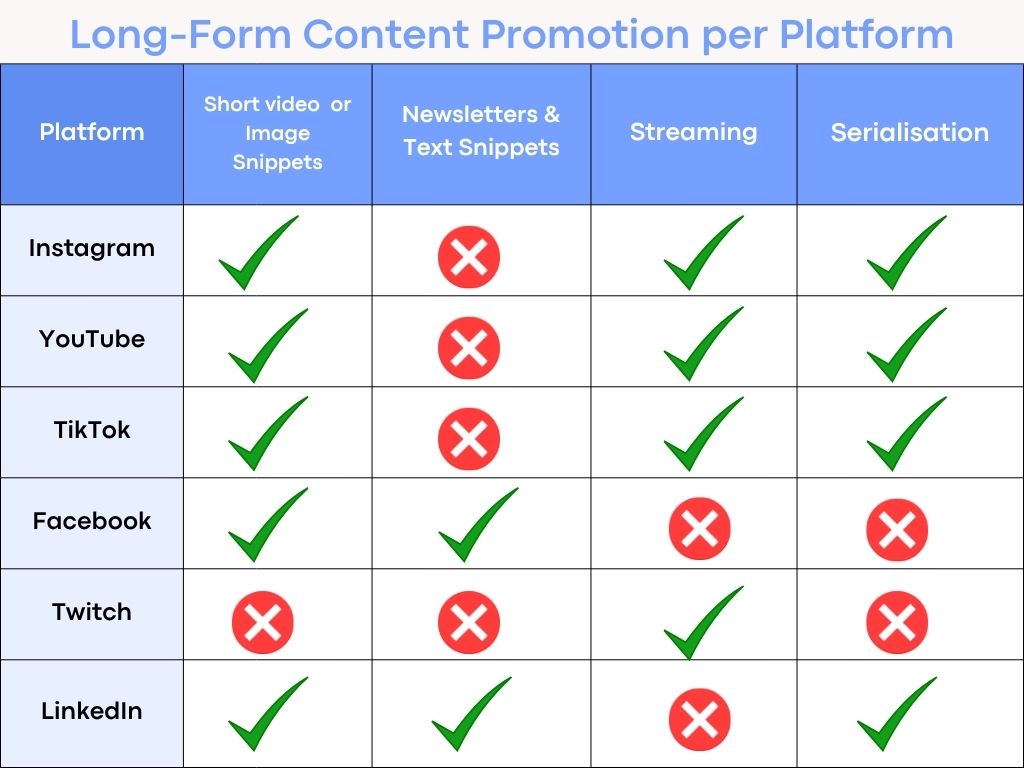
- Promotion: Social media itself may be more amenable to shorter clips, but this can be an advantage in advertising longer content. This is the same logic behind movie trailers: give a small taste to generate interest for a bigger piece. A short, interesting introduction to a larger piece can thrive on social media and funnel users to the actual content.
- Clipping: While it’s similar in concept to promotion, it’s a more post-hoc approach. Cut up a bigger piece of content into smaller ones after publishing to maximise reach for both short-term and long-term audiences. This makes sure you’re capturing multiple platforms and fostering viewer engagement. Podcasts thrive on this model.
- Quoted snippets: You can take longer articles and turn them into images with quotes or posts on micro-blogging platforms. This allows you to build interest in the written work or even get to the thrust of it for people who may not be interested in reading.
- Newsletters: You can turn a collection of long-form content into a newsletter. This allows social media users to see a compilation of articles with some summaries, allowing them to either get a taste or click on the fuller pages.
- Serialisation: Another viable strategy is to cut up a bigger chunk of content into something serialised and release it episodically. If you have an idea that only works in a bigger format, you may want to make it clear that it is part of a bigger whole. This can also have the added benefit of ritualising the consumption process with episodic releases.
- Livestreaming: Livestreaming is a social media feature that often does become longform. The use of FOMO in livestreaming, the ephemeral quality of taking part in a live online event, and the group dynamic of being on a stream all help propel longer content into being more digestible.
If you need help developing or promoting content, why not check out our marketing services? We provide end-to-end operations and strategy help to clients of all sizes.