



Zero-Click Content & Marketing Strategies
With the abundance of easy answers on AI, snippets, or even on various search components, clicking on external links has become less necessary. As answers become available from summaries or generated descriptions, marketers have had to adjust. That’s where zero-click content comes in. Let’s go over how to use zero-click marketing principles.
What is Zero-Click Marketing
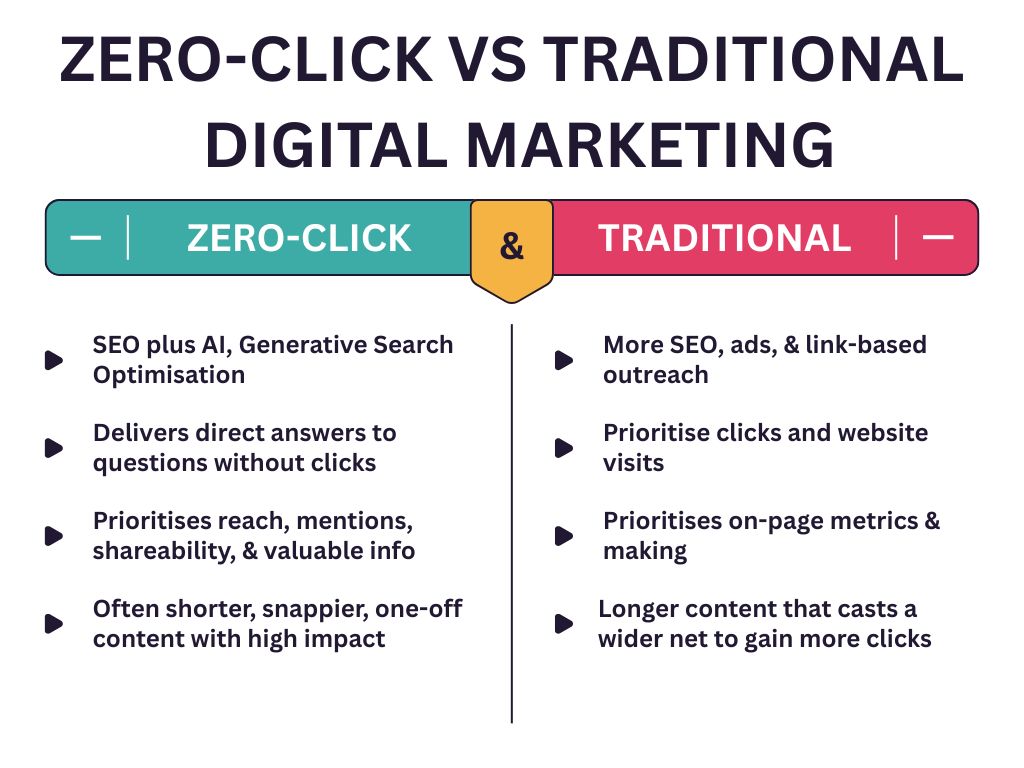
Zero-click marketing provides information about brands or products to users without having to generate a click on a platform or search engine. This can be convenient for users as it provides information more directly, while also eschewing the need for link placements and CTR strategies. In this way, it can provide instant answers and adapt to modern AI programs and automated snippets. However, this is not the only place where zero-click methods are useful, as they can also be handy for video content, branded advertising, and promotion.
According to research from Bain & Company, A vast majority of users (80%) will rely on zero-click results at least 40% of the time. Focusing on clickable results with the expectation that users will follow through on links means that you’re missing out on those who expect a frictionless experience and direct answers.
The need for less click-based strategies has become necessary in reaction to changes in how platforms present information. Internet users are more visual and friction-averse, meaning they want information with minimal hurdles and requiring less effort on their part. Addressing the rise of zero-click searches, marketers have come up with some alternative techniques. These include various AI optimisation, Generative Engine Optimisation, and search component optimisation techniques. These can allow companies to put their name out there in an environment where clicking is less preferred.
Zero-click marketing is most appropriate for search engines that are AI-first, ones that provide summaries, and brand marketing ads. In many ways, it incorporates more classical forms of marketing, since it is not relying on direct interaction with the ad or digital metrics like CTR. This can make it harder to measure, but there are many ways to do so (which we will discuss below).
Zero-Click Marketing Strategy
Rather than focusing on CTR and other click-based metrics, a zero-click strategy will emphasise pure visibility. So, here’s how to turn zero-click visibility into conversions and make them provide promotional utility:
- Create standalone content
Quick, concise, and to the point. Make sure you give the audience what you promised up-front, and without burying the lede. No part-twos, no links to other places, and no lead-ins to a link.
- Optimise for reach and engagement, not clicks
Zero-click search impacts CTR negatively, so you need alternative measures like engagement, reach, shares, and mentions. These will ensure that you’re getting views and that the content is resonating with people.
- Easier to read or view content
Readability scores come in handy here. Make sure to use bullet points, images, clear page design, and summaries where necessary. Structure helps keep the readers focused.
- Prioritise staying up to date with content and features
Aside from having the most recent content, you also need to jump on new features and formats early. Is there a new platform or way to post content? Monopolise your sphere on it quickly so you can make your mark. Being first is often more important than anything else when it comes to capturing the market. Experiment to find things others aren’t providing.
- Thought leadership and media relations
Publications, newsletters, and podcasts can provide information and value without demanding clicks. They can serve as vehicles of promotion through quality, shareability, or information rather than clickability.
How to Optimise For Zero-Click Searches
- Focus on AI & GEO
AI search optimisation and GEO principles work well here. Readability, recency, structure, bullet points, conversational writing, and high authority sources make content more AI-readable.
- Diversify content & branding materials
Find multiple avenues of attack. There are more ways to make use of engagement. Make a podcast and divide it into clips along with the full version. Turn articles into smaller social media posts. Make things available in every possible format. Crucially, measure all of the reach from these together as a block, as well as separately, to get an idea of the impact.
- Shorter content on socials
In practical terms, short-form video lengths need to be 60-90 seconds, posts should be 200-300 words, and image carousels should be 5-10 slides. Even long-form videos should be 2-3 minutes to maximise watch time.
- Crucial zero-click SEO elements
AI Overviews, featured snippets, knowledge panels, People Also Ask boxes, Local packs, Image, and video carousels all play a role in boosting visibility, even if they don’t get clicks. They can be crucial for those readers who desire digestible information. Roughly 1/3rd of searches do not end in a click, so these elements should not be neglected.
Metrics & Measurement

Learning how to measure ROI from zero-click searches can be a bit trickier than traditional methods. That said, here are some crucial metrics:
Core Visibility & Reach Metrics
- Share of Voice (SOV): Total presence in zero-click results across featured snippets, AI overviews, knowledge panels, and more. This is a measure that is relative to competitors, so it can be good for competitor analysis.
- Search Impressions: The number of times your target keyword or brand appears in search results without requiring a click. This can be a great metric for zero-click, as most standard SEO tools show this.
- Pixel Height / Position: Measures the visual prominence on the SERP, where a higher pixel position equals more visibility for your brand. This is basically how far under the start of SERP your first link appears. You can maximise this by being in the AI overview, featured snippets, and other components.
- AI Reach: How often your content appears in generative AI answers.
Brand & Engagement Metrics
- Brand Search Volume: Increases in branded search queries indicate growing awareness from zero-click exposure.
- Direct Traffic: Measures how many users are typing your URL directly. This is a good measure of brand recall.
- Social Shares & Engagement: Measures content shares while excluding clicks on links.
Conversion & Attribution Metrics
- Assisted Conversions: Zero-click touchpoints that contribute to conversions later in the journey.
- Influenced Conversions: Revenue/pipeline attributed to zero-click interactions even without direct click-through.
- Downstream Traffic Quality: Engagement metrics (bounce rate, time on page) for users who eventually click after initial zero-click exposure.
Redefining success from click-focused metrics to influence-based metrics can be crucial for many newer operations like AI search. Optimising for brand authority and topical depth rather than immediate traffic can be a good way to go about this as well. As more searches end without a visit to the site, old metrics might lead you astray from the actual value your SEO and marketing processes are providing.