


Google Marketing Live 2026: What Marketers Need to Know
Google Marketing Live 2026 took place on May 20th, showcasing all the new happenings in search, ads, and digital marketing. Let’s go over some of the most important new features.
Google Marketing Live has highlighted what the future of Google holds. The event showcased several updates to YouTube, Google Ads, and new Gemini add-ons to existing systems. Google is working forward to making its advertising far more conversational and AI-based. Alongside this, they are automating ad descriptions, streamlining product pipelines, and adding customer service features such as conversational ads that answer questions.
All of these features promise to shake up the way customers interact with ads, and how marketers make them. So, let’s dive deeper.
Google Marketing Live Ads Updates
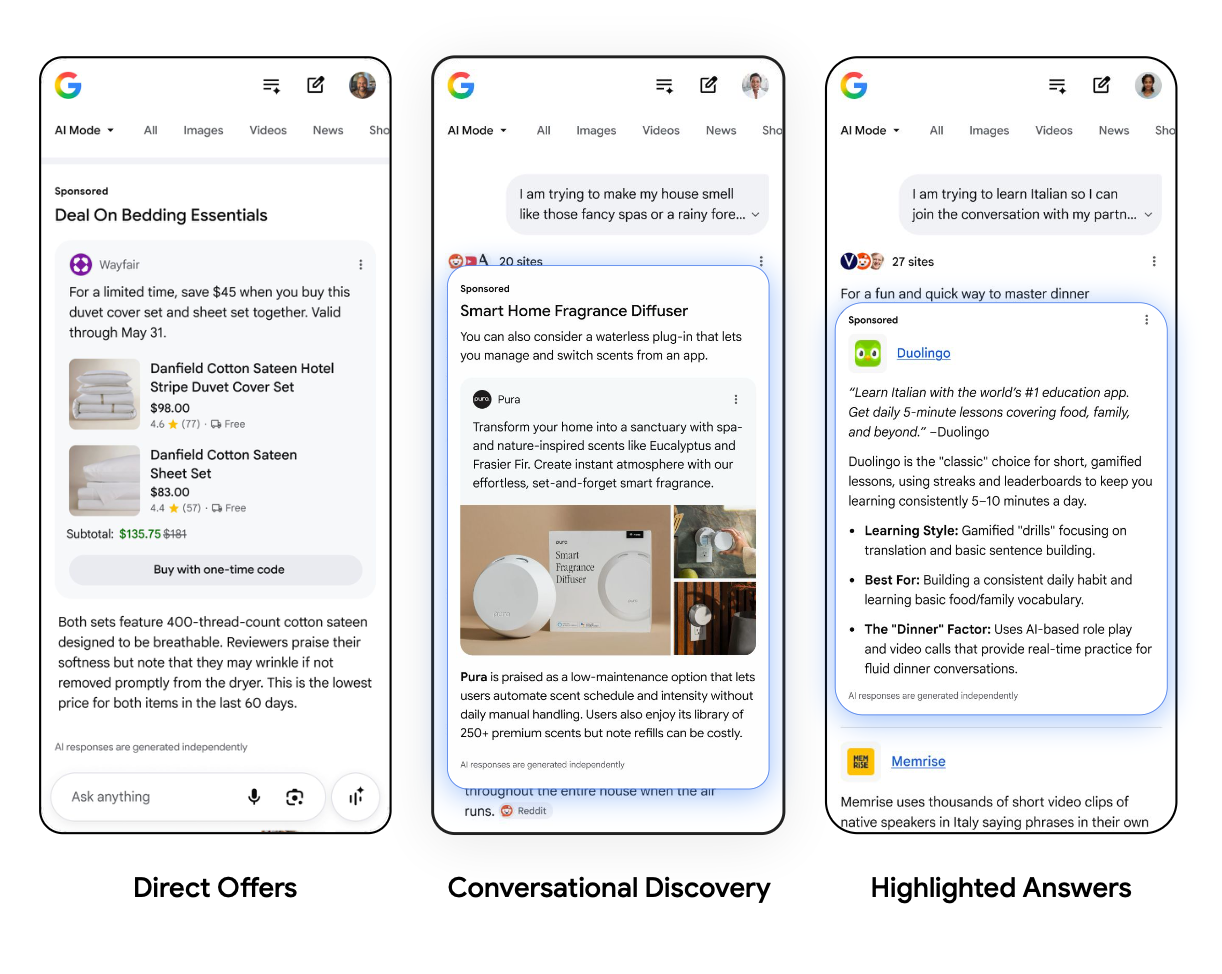
There are a few updates that will be quite relevant to marketing professionals. Among these is the new focus on conversational Google Ads. These new ad formats integrate directly into AI-generated responses, matching your offers closely, while remaining relevant to the consumer search, according to Google. These are powered by AI Max and Performance Max, which can also explain why a product is superior or will answer questions about it.
Here are some recommendations for using the new ads AI:
- Messaging: Give the Google AI clear parameters and boundaries, such as “never mention prices” or “focus on my summer collection.”
- Matching: The searches should be told what to capture or avoid, e.g., “avoid searches for in-person degrees.”
- Audience: Provide audiences with tailored messages, e.g., “for people who are health conscious, highlight our clean products.”
These ads are being pitched as a 24/7 sales representative. However, since these are all tied to Gemini, this raises a few concerns. Hallucinations are always a few rephrased questions away, so this might be a concern for businesses.
However, there are some supposed benefits, such as the analysis, where Gemini looks at what was said to find the best prospects, instead. It can supposedly reduce wasted budgets by filtering out misdials and low-intent calls. It can also show which ad led to a specific call, allowing for better performance tracking.
The AI will also maintain budget-pacing to avoid overspending, although how well this works is not yet clear. We will know the effectiveness of these features once enough companies pilot-test them.
Targeting Updates
One of the more interesting updates has been the ability to adjust for targeting unique customers rather than recurring ones. Google boasts that you can reach new customers as they’re in their discovery phase. Thanks to the new customer value mode, once you reach everyone, you can give a “bonus” value to new buyers. This improves scaling without losing existing customer volume.
According to their internal numbers, advertisers using the New Customer Acquisition Value Mode gain customer acquisitions at twice their average order value, with an improved ROAS by 9%. Conversely, the new customers only mode halts waste readership by filtering out your existing customers, focusing 100% of your budget on people who have never bought from you before. This can improve the new customer impression ratio by 11.5% with a -3% reduced acquisition cost.
Another feature worth talking about is the ability to calculate missed conversions and clicks. The AI will estimate how many conversions and clicks could have been achieved if your budget had been optimised properly. Here’s a look at the view:
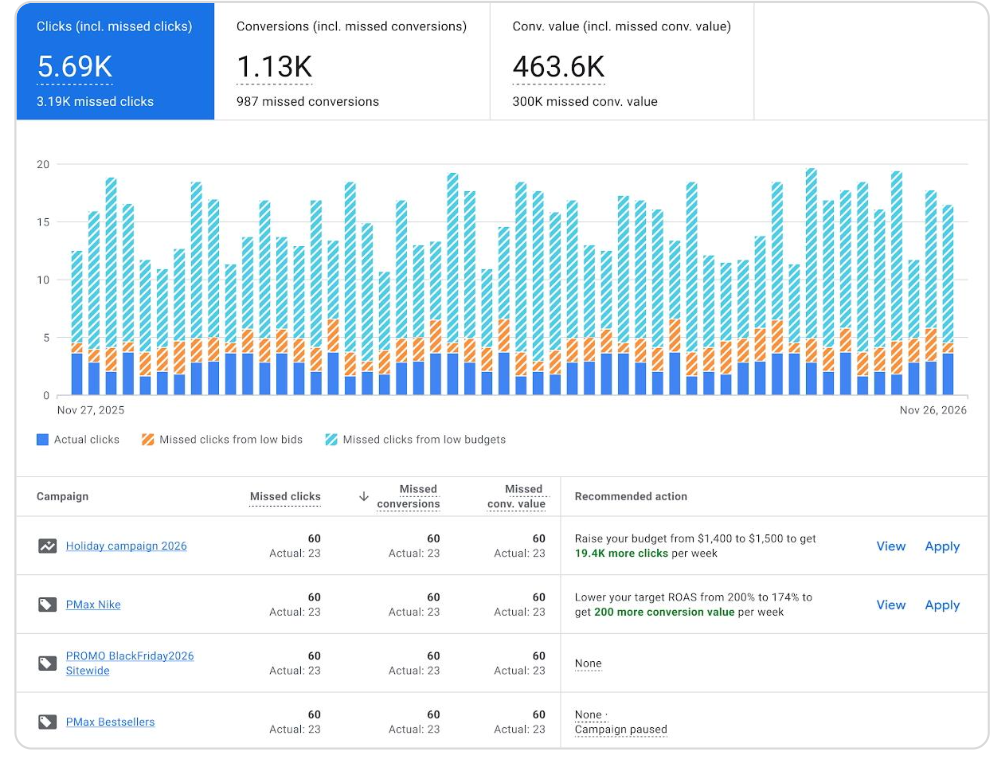
While the feature seems neat, how well it produces the numbers and their accuracy are still unknown. How it determines the optimal campaign is still not clear, so take the claims about its accuracy with a grain of salt.
AI Was the Main Topic At GML
The new features that Google’s ad creation platforms are boasting hinge on a lot of AI processes. The new process replaces standard product results with a Gemini-powered shopping experience that aims to highlight the most relevant products. Gemini is in the driver’s seat for a lot of these new processes. It may speed up workflows by providing product descriptions, translating technical specifications, and providing AI-generated summaries.
The new descriptions and summaries plan to delve deeper into the “why you should buy” pitch of the products. These can be more descriptive with the help of LLMs and the information you provide. It also allows for text customisation, which generates ad copy for your Shopping ads so that they speak directly to shopper intent and conversational queries.
The final URL Expansion (FUE) will also match your site’s most relevant landing pages to better suit the intent of the potential customer. The new features may also automatically select the best format according to their data, automating the selection process based on prior data. Google’s AI can add text or Shopping ads, based on what is most relevant to the shopper’s needs.
The AI also helps refine the ad content, using intelligent nudges and one-click AI fixes for common issues. This can be like adjusting the aspect ratio and logo placement to ensure campaigns are improving as they go on. Gemini is now also attuned to providing advice for the various ad tweaks you may want to do. While it provided advice in the past, the new format is more conversational rather than a simple bullet-point list.
YouTube Updates
The new YouTube updates may hold a lot of opportunities for marketers, allowing for new features that insert products into the videos and streamline the purchase pipeline. For example, you can potentially shorten the path to purchase by featuring ‘Shop’ CTAs on creator videos. These open a clear path for customers to go straight to stores as products appear in videos. Product catalogues have also been added to vertical formats for easier access for users.
YouTube is also encouraging the use of organic YouTube affiliate videos to build Credibility. This involves using trusted creators for instant brand credibility and better intent targeting for customers. Google are recommending understanding the new features as a means of amplifying the reach of proven, product-focused creator reviews and tutorials.
You can also use the features to elevate your campaign by boosting creator videos directly within the Google Ads asset picker. This can be done during the campaign setup stage. The new system will automatically identify relevant creator content that fits with your brand. The best route to leverage this feature is to tie your brand to trusted creator voices to increase campaign authenticity and engagement.
Marketers can reduce creative production time with the use of a suggested video content library from creators you can pull into your campaigns. The new hyper-personalised video ads can now circumvent the 5-video upload limit by leveraging your entire GMC video library. This workaround can be great for creating a reference library for your product-related videos.
Some better algorithmic changes promise to dynamically serve product-specific videos that take real-time user intent and interest into account. The aim is to reduce creative overhead by automating the delivery of structured, product-focused video content throughout YouTube. This improves campaign relevance and performance through AI-driven video-to-user matching.
Ultimately, these changes are intended to drive better results with minimal effort by offering a way to check out directly from an ad. This minimised friction can help get better return on marketing investment.